I got word today that the 2017 edition of Mémento was now available on the Est-Nord-Est website. Understandably, the past few years have been demanding for the organization, with the construction of a new building, staff turnover, and a global pandemic, but now their documentation is up to date, and on a new website too. You can download a pdf of the publication by clicking on the cover image below.
The publication covers the three residency periods that were held at Est-Nord-Est in 2017, and my essay describes the work of the artists in the Fall residency, for which I was the writer in residence.
On the Passage of a Few
People…
On my way from Ottawa to
Est-Nord-Est in Saint-Jean-Port-Joli, I was thinking about “infrastructures of resonance.” The phrase
had just been introduced to me by a professor at Carleton University when I was
giving a tour of an exhibition that I had curated about the punk rock scene in
Ottawa in the 1980s. He had been teaching the concept with reference to Nato
Thompson’s Seeing Power (2015), and
he told his class that the punk rock zines in the exhibition were perfect
examples. Thompson describes infrastructures of resonance as projects that form
a network of affiliations, and you can certainly see this in a zine as it gets
circulated and shared by fellow punks. A zine, like any work of art, not only
makes ideas public but also creates a public through its reception.
Approaching Saint-Jean-Port-Joli, along the river. Photo: Michael Davidge
Through their programming, publications, and other
activities, artist-run centres such as Est-Nord-Est could also be considered
infrastructures of resonance. Operating in communities both big and small across
Canada, they actively promote and support the production and exhibition of
contemporary art and the exchange of ideas that offer an alternative, and often
critical, point of view on mainstream culture. I was looking forward to meeting
and conversing with the other artists in residence: Jennifer Belair, Sophie
Madeleine Jaillet, Christoph Mügge, and Céline Struger. In advance of the
residency, I had another phrase in mind: “On the passage of a few people
through a rather brief moment in time.” Many years ago, a friend of mine lent
me an exhibition catalogue with that title, taken from a film made by Situationist
theorist Guy Debord, and it has continued to resonate with me. I was thinking
of it partly because of the connections between Situationism and punk rock, but
also because of the generic yet poignant applicability of the phrase. I wondered
what encounters or exchanges had influenced or inspired the other artists at
Est-Nord-Est. I would try to find out over the course of the next month.

Céline Struger, Studio installation view (detail), 2017. Photo: Jean-Sébastien Veilleux.
The body of work that Céline Struger developed during her
two-month stint at Est-Nord-Est was the most directly inspired by the
environment surrounding the artists’ residence and studios. Struger is an Austrian
artist from Vienna who works in installation as a counterpoint to virtual
reality. She uses both found and fabricated materials to create an alternate
reality that questions concepts of value. The prominence of the St. Lawrence
River in Saint-Jean-Port-Joli was manifested in the forms of the pieces that
Struger created for an installation in her studio, which were derived either
from a sketch that she drew of the shore of the river and its fascinating rock
formations or from the objects that she found strewn along the shore, such as plastic
six-pack rings. The installation incorporated these objects, including a
sizable piece of charred wood and a rusted-out piece of machinery, suggesting
an equivalency among the forms. A number of the pieces were ceramics fired in
the Est-Nord-Est studio kilns. All of the ceramics were treated with an Obvara glaze,
introduced to Struger by Judith Dubord, a local artist. Est-Nord-Est encourages
and facilitates such interactions between local and visiting artists. Obvara firing,
which creates a surface pattern that is said to ward off the evil eye, appealed
to Struger because of her interest in the power of materials, both literal and
symbolic. Through her treatment, quotidian objects are transformed into alien
life forms that invite a re-evaluation of what can be known about them.
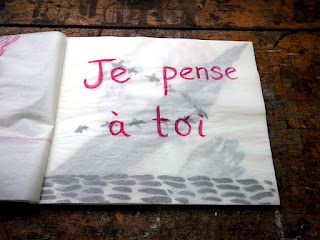
Jennifer Belair, Studio installation view (detail), 2017. Photo: Jean-Sébastien Veilleux.
Because her practice is conceived as a kind of
journaling, the work that Jennifer Belair produced at Est-Nord-Est also
contained a strong connection to its location in Saint-Jean-Port-Joli. Belair is
an American artist currently living in Detroit, Michigan. With a printmaking
background, she generally works on paper and makes drawings that incorporate
observations of her surroundings with snatches of overheard conversations or
thoughts that reflect her mental state at the time of their composition. For a
while now, she has been working in a vein that mines the romantic tradition of
the landscape genre, and the environs of the Bas-Saint-Laurent region lent themselves
easily to this tendency in her work. Languages other than English appear in her
drawings as a way to reach different audiences and as a visual element that
expresses otherness. Reflecting the context in which she found herself, French
appears in the drawings she made in Saint-Jean-Port-Joli. A fan of country-and-western
music, also because of its romanticism, Belair expanded her pantheon of musical
heroes when she discovered French-Canadian country and western singer Willie
Lamothe on the cover of a magazine in the local grocery store. She also ran a
bookmaking workshop organized by Est-Nord-Est. By teaching a group of women at the
Centre-Femmes La Jardilec to produce their own books that could be used as
journals, she was a source of inspiration for Saint-Jean-Port-Joli as much as
she drew inspiration from it.

Sophie Madeleine Jaillet, Studio installation view (detail), 2017. Photo: Jean-Sébastien Veilleux.
Although her work is very much about the environment, Sophie
Madeleine Jaillet did not draw specifically from Saint-Jean-Port-Joli for the
subject matter of the work produced during her residency. A French-Canadian
artist who lives and works in Montreal, Jaillet makes art as a method of performing
the Anthropocene, the current geological period in which human activity is the dominant
influence on climate and the environment. Her work often appears to be a kind
of science experiment that renders abstract thought tangible. While at
Est-Nord-Est, she made a series of “drawings” on Mylar by melting blocks of ice
with graphite frozen within them, producing a visual analogue for the process
of glaciation. Jaillet was also working on a piece that included a small set of
quartz Platonic solids that represent an obsolete paradigm for understanding
the universe. These solids are to be eroded in a rock tumbler. Although she works
in a broader way with the environment, while in residence Jaillet took
advantage of the specific resources that Est-Nord-Est makes available to
artists and worked closely with technician Richard Noury to create fine wooden
boxes and display cases for the Platonic solids. Through her work, and through
the interactions that she has with people about it, she raises concerns about
the intangibility of science and strikes a cautionary note. By asking questions
that aren’t typically posed (by asking scientists “Are you hopeful for the
future?” for example), she fulfils an important artistic role.

Although the work that Christoph Mügge produced during
his residency seems the furthest removed from the context of Saint-Jean-Port-Joli,
there is still an underlying connection with it. A German artist who lives and
works in Malmö, Mügge created a series of woodcut prints that drew inspiration
from the signs for bomb shelters, or skyddsrum,
that are prevalent in Sweden. With a background in painting, Mügge has more recently
turned to making large-scale installations with trash and recycled materials. In
doing so, he comments on consumer society by revealing the excess of waste that
is available for him to work with. At Est-Nord-Est, Mügge was able to use scraps
from the wood shop to create his work. By the end of his residency, Mügge had
finished a series of 36 editioned prints, each of them based on the design of the
Swedish signs (featuring a blue triangle in an orange square) and incorporating
cultural references related to bomb shelters. For example, in one of his prints
the blue triangle resembles the shell of Bert the Turtle, the cartoon star of
the “social guidance” film Duck and Cover
produced in the United States during the height of the Cold War. With the
heightening tensions among nuclear powers today, it is not surprising that Mügge
would be focusing on this subject. However, it is also not that surprising that
he produced a woodcarving of a turtle during his residency, given the rich
history of woodcarving in Saint-Jean-Port-Joli.
As our residency drew to a close, the artistic director, Dominique
Allard, asked all of the participants to give a list of five texts or
references related to our research and production at Est-Nord-Est so that she can
share them on the centre’s website. My list includes London Orbital (2002) by Iain Sinclair, which I managed to finish
reading while I was there. From Sinclair’s book I gleaned an important
distinction between the Greek philosophical concepts of chora and topos, which
could be roughly translated as space and place, respectively. Est-Nord-Est is a
kind of space that is oriented to being open to the acceptance of different
ways of looking at things, and to different people who come from all over the
world, if only for a brief moment in time. Although our list of references
undoubtedly informed our production at Est-Nord-Est, I would say it was our
encounter with the place where it is located and with the people who are there
that had an even greater influence. As an infrastructure of resonance, the
significance of the residency is further relayed through the projects that it
supports and sends back out into the world.


