Showing posts with label Writing. Show all posts

Thursday, October 30, 2025

vert soleil green sun at AXENÉO7, Gatineau

Pologne-en-Québec, a major video installation in two galleries at AXENÉO7 by Kinga Michalska and Sarah Chouinard-Poirier, is undoubtedly the best work of art about the pandemic that I have seen yet, tapping into the insecurities, fears, and sense of potentiality that existed during the suspended time of the lockdowns. It is in fact a product of a so-called Autoresidency at the centre, which was the method of providing support to artists they instituted during that period. Elements in the videos appear in the physical environments created for their viewing, loosening the boundaries between the two as well as contributing to the blurring of the lines between reality and fiction that occurs in them.

Kinga Michalska & Sarah Chouinard-Poirier, Pologne-en-Québec, 2025, installation view (courtesy of AXENÉO7; photo: Emma Jacques)

In a third gallery, another Autoresidency project by AM Trépanier, soif de communauté / hungry for community, presents oral, visual, and archival documentation of rural communes created by women, trans, and non-binary people in the area. At least one still from Pologne-en-Québec appears in this material, mingling fact with fantasy. The oral histories are also presented in a fanciful manner on audio cassette players resting on a low table with funky cushions, connecting again with the work presented in the other galleries. Both projects engagingly explore the pleasures and pitfalls of interpersonal dynamics and the lure of nostalgia. The complete text of my review of the exhibition was published here on the October 30 Akimblog. 

Thursday, May 29, 2025

Joyce Wieland at the National Gallery of Canada, Ottawa

Pucker Up! The Lipstick Prints of Joyce Wieland is billed as a vignette exhibition, presented in association with a major retrospective of Wieland’s work, Heart On. Celebrating an acquisition that completes the National Gallery of Canada’s collection of Wieland’s so-called lipstick prints, this show is an amuse-bouche in relation to the travelling survey; nevertheless, when considered alongside works by other artists currently on view at the gallery, Pucker Up!’s limited scope still underscores Wieland’s concerns with equity and cultural sovereignty in a manner that resonates with current debates.

Joyce Wieland, The Arctic Belongs to Itself, 1973, lithograph on wove paper (© National Gallery of Canada; photo: NGC)

I recalled Wieland on the same visit while viewing the New Generation Photography Award exhibition where I encountered the work of asinnajaq, a Canadian Inuk artist from Inukjuak, Quebec.  Featuring details of nature and terrain, her prints, unframed and affixed to the wall with magnets, or on a piece of synthetic fabric bunched up in the centre of space, reminded me of the provisional and performative aspects I discerned in Wieland’s work. Through artworks like The Arctic Belongs to Itself (included in Pucker Up!), Wieland raised awareness about Indigenous rights and the threat of environmental devastation. In accordance with Inuit values, asinnajaq similarly expresses a love of the land. Her video holding piece, like Weiland's work, suggests that an act of loving care can also be an act of resistance. The complete text of my review of the exhibition was published here on the May 29 Akimblog. 

Monday, April 19, 2021

On the Passage of a Few People...

I got word today that the 2017 edition of Mémento was now available on the Est-Nord-Est website. Understandably, the past few years have been demanding for the organization, with the construction of a new building, staff turnover, and a global pandemic, but now their documentation is up to date, and on a new website too. You can download a pdf of the publication by clicking on the cover image below. 

Mémento 2017

The publication covers the three residency periods that were held at Est-Nord-Est in 2017, and my essay describes the work of the artists in the Fall residency, for which I was the writer in residence. 

On the Passage of a Few People…

On my way from Ottawa to Est-Nord-Est in Saint-Jean-Port-Joli, I was thinking about “infrastructures of resonance.” The phrase had just been introduced to me by a professor at Carleton University when I was giving a tour of an exhibition that I had curated about the punk rock scene in Ottawa in the 1980s. He had been teaching the concept with reference to Nato Thompson’s Seeing Power (2015), and he told his class that the punk rock zines in the exhibition were perfect examples. Thompson describes infrastructures of resonance as projects that form a network of affiliations, and you can certainly see this in a zine as it gets circulated and shared by fellow punks. A zine, like any work of art, not only makes ideas public but also creates a public through its reception.


Approaching Saint-Jean-Port-Joli, along the river. Photo: Michael Davidge

Through their programming, publications, and other activities, artist-run centres such as Est-Nord-Est could also be considered infrastructures of resonance. Operating in communities both big and small across Canada, they actively promote and support the production and exhibition of contemporary art and the exchange of ideas that offer an alternative, and often critical, point of view on mainstream culture. I was looking forward to meeting and conversing with the other artists in residence: Jennifer Belair, Sophie Madeleine Jaillet, Christoph Mügge, and Céline Struger. In advance of the residency, I had another phrase in mind: “On the passage of a few people through a rather brief moment in time.” Many years ago, a friend of mine lent me an exhibition catalogue with that title, taken from a film made by Situationist theorist Guy Debord, and it has continued to resonate with me. I was thinking of it partly because of the connections between Situationism and punk rock, but also because of the generic yet poignant applicability of the phrase. I wondered what encounters or exchanges had influenced or inspired the other artists at Est-Nord-Est. I would try to find out over the course of the next month.

Céline Struger, Studio installation view (detail), 2017. Photo: Jean-Sébastien Veilleux.

The body of work that Céline Struger developed during her two-month stint at Est-Nord-Est was the most directly inspired by the environment surrounding the artists’ residence and studios. Struger is an Austrian artist from Vienna who works in installation as a counterpoint to virtual reality. She uses both found and fabricated materials to create an alternate reality that questions concepts of value. The prominence of the St. Lawrence River in Saint-Jean-Port-Joli was manifested in the forms of the pieces that Struger created for an installation in her studio, which were derived either from a sketch that she drew of the shore of the river and its fascinating rock formations or from the objects that she found strewn along the shore, such as plastic six-pack rings. The installation incorporated these objects, including a sizable piece of charred wood and a rusted-out piece of machinery, suggesting an equivalency among the forms. A number of the pieces were ceramics fired in the Est-Nord-Est studio kilns. All of the ceramics were treated with an Obvara glaze, introduced to Struger by Judith Dubord, a local artist. Est-Nord-Est encourages and facilitates such interactions between local and visiting artists. Obvara firing, which creates a surface pattern that is said to ward off the evil eye, appealed to Struger because of her interest in the power of materials, both literal and symbolic. Through her treatment, quotidian objects are transformed into alien life forms that invite a re-evaluation of what can be known about them.


Jennifer Belair, Studio installation view (detail), 2017. Photo: Jean-Sébastien Veilleux.

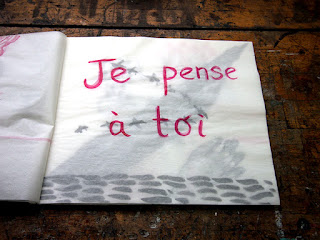
Because her practice is conceived as a kind of journaling, the work that Jennifer Belair produced at Est-Nord-Est also contained a strong connection to its location in Saint-Jean-Port-Joli. Belair is an American artist currently living in Detroit, Michigan. With a printmaking background, she generally works on paper and makes drawings that incorporate observations of her surroundings with snatches of overheard conversations or thoughts that reflect her mental state at the time of their composition. For a while now, she has been working in a vein that mines the romantic tradition of the landscape genre, and the environs of the Bas-Saint-Laurent region lent themselves easily to this tendency in her work. Languages other than English appear in her drawings as a way to reach different audiences and as a visual element that expresses otherness. Reflecting the context in which she found herself, French appears in the drawings she made in Saint-Jean-Port-Joli. A fan of country-and-western music, also because of its romanticism, Belair expanded her pantheon of musical heroes when she discovered French-Canadian country and western singer Willie Lamothe on the cover of a magazine in the local grocery store. She also ran a bookmaking workshop organized by Est-Nord-Est. By teaching a group of women at the Centre-Femmes La Jardilec to produce their own books that could be used as journals, she was a source of inspiration for Saint-Jean-Port-Joli as much as she drew inspiration from it.


Sophie Madeleine Jaillet, Studio installation view (detail), 2017. Photo: Jean-Sébastien Veilleux.

Although her work is very much about the environment, Sophie Madeleine Jaillet did not draw specifically from Saint-Jean-Port-Joli for the subject matter of the work produced during her residency. A French-Canadian artist who lives and works in Montreal, Jaillet makes art as a method of performing the Anthropocene, the current geological period in which human activity is the dominant influence on climate and the environment. Her work often appears to be a kind of science experiment that renders abstract thought tangible. While at Est-Nord-Est, she made a series of “drawings” on Mylar by melting blocks of ice with graphite frozen within them, producing a visual analogue for the process of glaciation. Jaillet was also working on a piece that included a small set of quartz Platonic solids that represent an obsolete paradigm for understanding the universe. These solids are to be eroded in a rock tumbler. Although she works in a broader way with the environment, while in residence Jaillet took advantage of the specific resources that Est-Nord-Est makes available to artists and worked closely with technician Richard Noury to create fine wooden boxes and display cases for the Platonic solids. Through her work, and through the interactions that she has with people about it, she raises concerns about the intangibility of science and strikes a cautionary note. By asking questions that aren’t typically posed (by asking scientists “Are you hopeful for the future?” for example), she fulfils an important artistic role.


Christoph Mügge, Studio installation view (detail), 2017. Photo: Jean-Sébastien Veilleux.

Although the work that Christoph Mügge produced during his residency seems the furthest removed from the context of Saint-Jean-Port-Joli, there is still an underlying connection with it. A German artist who lives and works in Malmö, Mügge created a series of woodcut prints that drew inspiration from the signs for bomb shelters, or skyddsrum, that are prevalent in Sweden. With a background in painting, Mügge has more recently turned to making large-scale installations with trash and recycled materials. In doing so, he comments on consumer society by revealing the excess of waste that is available for him to work with. At Est-Nord-Est, Mügge was able to use scraps from the wood shop to create his work. By the end of his residency, Mügge had finished a series of 36 editioned prints, each of them based on the design of the Swedish signs (featuring a blue triangle in an orange square) and incorporating cultural references related to bomb shelters. For example, in one of his prints the blue triangle resembles the shell of Bert the Turtle, the cartoon star of the “social guidance” film Duck and Cover produced in the United States during the height of the Cold War. With the heightening tensions among nuclear powers today, it is not surprising that Mügge would be focusing on this subject. However, it is also not that surprising that he produced a woodcarving of a turtle during his residency, given the rich history of woodcarving in Saint-Jean-Port-Joli.

As our residency drew to a close, the artistic director, Dominique Allard, asked all of the participants to give a list of five texts or references related to our research and production at Est-Nord-Est so that she can share them on the centre’s website. My list includes London Orbital (2002) by Iain Sinclair, which I managed to finish reading while I was there. From Sinclair’s book I gleaned an important distinction between the Greek philosophical concepts of chora and topos, which could be roughly translated as space and place, respectively. Est-Nord-Est is a kind of space that is oriented to being open to the acceptance of different ways of looking at things, and to different people who come from all over the world, if only for a brief moment in time. Although our list of references undoubtedly informed our production at Est-Nord-Est, I would say it was our encounter with the place where it is located and with the people who are there that had an even greater influence. As an infrastructure of resonance, the significance of the residency is further relayed through the projects that it supports and sends back out into the world.

Thursday, February 25, 2021

Neeko Paluzzi at the Karsh-Masson Gallery, Ottawa City Hall

I wrote the exhibition essay for Neeko Paluzzi's The little prince, an exhibition at the Karsh-Masson Gallery at Ottawa City Hall from February 25, 2021 to April 11, 2021. In spite of the disruptions caused by the pandemic, it was a pleasure to be involved and to see the exhibition installed. The text of the essay was only available as a didactic on a wall in the gallery, so I am reproducing it here in full:

Constellations.

Neeko Paluzzi, Homunculus (detail), 2019, pigment ink on cotton rag 

It is always entertaining and illuminating to hear Neeko Paluzzi talk about his artwork. His technically rigorous approach to making art is matched by an intellectual curiosity that drives its production. He is usually either in the finishing stages of an ambitious project or embarking on a new one. The artist imbues each project with great significance through copious research and reference materials. At first, his work can appear abstract and seem to transmit minimal information. However, the work remains sufficiently open to interpretation for viewers to connect with it in their own way.

For example, when I met him to talk about the work displayed in his exhibition The little prince, he noticed that my notebook had a constellation of stars on its cover. It was a happy coincidence that this image should relate to the content of the exhibition, which explores outer spaces, both real and imagined. Later in our conversation, Paluzzi mentioned that he is from the small town of Turkey Point, Ontario. I remembered seeing old photographs of my Dad’s family spending their summer vacations there, years ago. Auspicious coincidences like these can accrue around a work of art and lend it a patina of significance. 

If such coincidences or associations are given any weight, they can form a constellation of ideas that provide a framework for interpreting an exhibition. With his exhibition at the Karsh-Masson Gallery, Paluzzi refers to the children’s book by Antoine de Saint-Exupéry. The book mourns the loss of imagination that often occurs when a child grows into adulthood. Tellingly, the book is dedicated not to the grown-up dedicatee but to the child from whom he grew. Viewers who have read the book will be able to bring their own recollections of it to bear on their visit to the gallery.

Neeko Paluzzi, The view from my bedroom (left) | The little prince, 2020 (right)

Even those unfamiliar with the book will surely notice the atmosphere of nostalgia and references to childhood that permeate the exhibition. One image shows the artist as a little kid, dreaming of becoming an astronaut, his face peeking out of a photo stand-in spacesuit. The body of work on view was actually inspired by a visit to Paluzzi’s childhood home. He describes the experience of sleeping in his old bedroom, represented by an enlarged photograph in the exhibition: “Once the feelings of nostalgia faded, thoughts entered my mind about failing to become who I wanted to be.” However, the work in the exhibition does not simply capture this notion of realizing your limitations as you age. It is also very much about addressing these limitations and overcoming them through imagination and art. Paluzzi may not have grown up to be an astronaut, but through his art he can project himself, and his audience, into outer space.

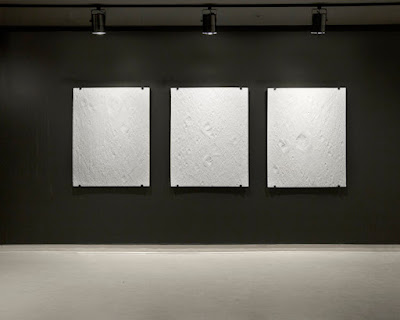
At the centre of the exhibition is a series of images directly inspired by the narrative of The Little Prince. Seven dioramic images of seven sculpted figures on seven little planets/asteroids roughly correspond to the characters in the book: the king, the flower, the snake, etc. (These images have also been prepared to be seen through a View-Master, another item that Paluzzi associates with his childhood.) It is not easily discernible that many of the figures in the images are actually 3D printed miniatures of Paluzzi’s body. With these images, Paluzzi exploits the characteristics of photography to lend a real existence to the subjects depicted. 3D printing also enables Paluzzi to underscore the sculptural qualities of photography. In this vein, the artist brings the lunar surface within reach by hanging, on the back wall of the gallery, a series of 3D etched wood sculptures that replicate photographic images taken of the Moon in 1968. 


Neeko Paluzzi, Moon, flattened 1968, 2019

It might appear that the strength of Paluzzi’s practice lies in the one-to-one relationship he sets up between his artworks and what they depict. However, the looser associations are what allow for greater communication. For example, in a related body of work Harmony of the spheres (2020), Paluzzi created a series of  tone photos based on Johannes Kepler’s Harmonices Mundi, published in 1619. This text actually notates the music of the spheres, an ancient concept according to which the planets move in harmony, and assigns musical scales to each of the six known planets, as well as the Moon. Following a method that he developed for previous projects, Paluzzi uses darkroom equipment to create photographic prints in which tones of gray are directly associated with musical tones. Each of the seven prints in the series has a different tone of gray. These seven tones correspond to the chords of Kepler’s planets, which Paluzzi  associates in number with the celestial bodies visited by the Little Prince. How far the viewer is willing to go along with the connections suggested by Paluzzi may depend on how deeply they accept the moral of Saint-Exupéry’s story: “It is only with the heart that one can truly see. What is essential is invisible to the eye.” 

Replete with well-known and obscure references, as well as suffused with a relatable personal history, Paluzzi’s exhibition gives the viewer multiple entry points. Correspondingly, Paluzzi has produced the image of his childhood bedroom so that the window by his bed is a blank screen upon which viewers can project. You can imagine looking out the window and daydreaming of what lies beyond, be it Turkey Point or some more distant realm. Though Paluzzi has focused on his failure to realize a childhood dream, he has also transcended limits with imagination.

Friday, October 30, 2020

SAW Prize for New Works in Critical Writing

I am delighted to announce and honored that I have been selected as one of the recipients of the SAW Prize for New Works. Along with 30 other artists and makers from Ottawa-Gatineau and the surrounding First Nations, I have been given a great opportunity to create a new work with financial and organizational support provided by Galerie SAW Gallery.


I have been awarded a SAW Prize for New Works in Critical Writing, and the focus of the new text that I am going to produce will be on contemporary artists in the Ottawa-Gatineau area. I am also very excited to see what my cohorts come up with for their new productions.

Wednesday, October 14, 2020

Moyra Davey at the National Gallery of Canada, Ottawa

The Faithful, a survey exhibition of the decades-long career of Moyra Davey, brings together a body of work and weaves a dense web of references that warrants close readings. Working with text, video, and photography, the Canadian-born, New York-based artist examines her personal history and its connections to art, film, and literature to construct narratives that give meaning to her experience at the same time that they refrain from reaching any simple conclusions.

Moyra Davey, i confess (video still), 2019. HD video with sound (courtesy greengrassi, London, and Galerie Buchholz, Berlin/Cologne/New York) © Moyra Davey (photo: courtesy the artist)

At the center of the exhibition is a recent video titled i confess, which bridges an appreciation of the American author James Baldwin with a reexamination of Pierre Vallières, the Quebec writer who compared the separatist movement with civil rights struggles in the US. On the 50th anniversary of the October Crisis, amid anti-Black racism protests, its presentation in Ottawa couldn’t be more timely. Like Davey’s other work, it also reveals personal details of her own life, delving into her father’s possible role in the invocation of the War Measures Act, and her ex-boyfriend’s relationship with Vallières. 

There is a recurring motif in a number of the videos in the exhibition, where Davey goes over to an open window in her apartment and blows the dust off the top of one of her books. It is a ritualistic gesture that suggests we must repeatedly reexamine the past, our own memories, and received ideas. The complete text of my review of the exhibition was published here on the October 14 Akimblog. 

Thursday, September 3, 2020

Neeko Paluzzi at Studio Sixty Six, Ottawa

Neeko Paluzzi's Harmony of the Spheres (from August 21 to Sept. 13) is one of the few exhibitions I got out to see at a gallery since everything went into lockdown in March at the start of the pandemic. For this exhibition, the artist has systematically produced seven photography-based works that represent the seven heavenly bodies (including the moon) that comprised the known planets when the astronomer Johannes Kepler wrote Harmonices Mundi in 1619. In his treatise, Kepler transcribed the tones attributed to the planets, which, according to the ancient concept of the Harmony of the Spheres, together made a sound that showed the harmonious perfection of Divine creation. Utilizing a method he developed in previous installations, including This place is a shelter (2018) and The goldberg variations (2019), Paluzzi worked in the darkroom to produce prints with unique tonalities of gray that correspond to the musical tones associated with each of the seven planets.

Neeko Paluzzi, Music of the moon, 2020, silver gelatin print and silver leaf embossed matte in custom frame

It was hard not to read the work in the context of the ongoing quarantine, where it took on overtones outside of the rigorous framework in which it was conceived. Indeed, especially due to the disruptions we are experiencing these days, one can find succor in impeccably realized creations embodying an outdated worldview that sees perfection in a pre-ordained order. On the other hand, it is important to note the element of subterfuge in these prints that underscores how most often phenomena are given their meaning by the way they are framed. The complete text of my review of the exhibition was published here on the September 3 Akimblog.

Thursday, November 28, 2019

Àbadakone at the National Gallery of Canada, Ottawa

Àbadakone is the second in a series of international Indigenous art exhibitions that was inaugurated in 2013 with Sakahàn. With reference to the fact that the National Gallery of Canada resides in traditional Algonquin territory, both exhibitions have titles in Algonquin. As Sakahàn is a word that means “lighting a fire” in English, it is totally apt that Àbadakone should mean “the fire continues to burn,” or in the trilingual title of the exhibition: Continuous Fire


Joar Nango, Sámi Architectural Library, 2019, detail of installation (photo: Michael Davidge)

This exhibition further establishes the NGC as a centre for dialogues that contribute to the writing of international Indigenous art histories. It also makes it a place to see some extraordinary contemporary Indigenous art from around the world, with work by more than seventy artists from at least sixteen diverse countries including Benin, China, Guatemala, India, Indonesia, Japan, New Zealand, Russia, and South Africa. Significantly, these artists in total identify with approximately forty Indigenous nations, ethnicities, and tribal affiliations within and across the countries listed, traversing boundaries and shifting a visitor’s understanding of the global map.

In the complete text of my review, posted here on the November 28 Akimblog, I dwell on one work that is particularly emblematic of this shift in perspective: the Sámi Architectural Library by Joar Nango, a Sámi artist and architect from Sápmi (a cultural region that stretches over Norway, Sweden, Finland, and Russia). For Nango, the paramount goal is the transmission of Indigenous knowledge. His library offers a dynamic model for decolonization.

Tuesday, August 20, 2019

Sex Life at Galerie SAW Gallery, Ottawa

Galerie SAW Gallery is open again with a strengthened presence and a bracing new show. Curated by Jason St. Laurent, Sex Life: Homoeroticism in Drawing delivers on its promise not to shock or titillate (although the potential for that is abundant), but rather to foster an expanded view of human desire and sexual practices. 

Cindy Baker, Crash Pad, 2017, watercolour on paper

Artists in the show – and featured in a special issue of HB magazine that serves as an exhibition catalogue – include Cindy Baker, Panos Balomenos, Dave Cooper, G.B. Jones, Sholem Krishtalka, Zachari Logan, Kent Monkman, Diane Obomsawin, and Mia Sandhu. They are also joined by a host of even more artists in a series of vitrines that contain additional works – mainly publications such as graphic novels, bandes dessinées, manga, underground comix, and zines. The inclusion of these materials situates the work in the show within a global community. Sex Life imagines a community representing sexual freedom explicitly in contrast to the rise of right-wing conservatism worldwide. The complete text of my review of the exhibition was published here on the August 20 Akimblog.

Wednesday, August 14, 2019

A Speculative Process: Reading Jayce Salloum’s Mute Pictures

My article on Jayce Salloum's remembering you (mute pictures) is featured in the National Gallery of Canada's Magazine. The early work, completed by Salloum between 1987 and 1988, is included in Photography in Canada 1960–2000, an exhibition organized by the National Gallery of Canada's Canadian Photography Institute and on view at the Judith & Norman Alix Art Gallery in Sarnia, Ontario. 


Jayce Salloum, Untitled, from remembering you (mute pictures), 1987–88. Gelatin silver print, heightened with paint, 20.3 x 25.2 cm. CMCP Collection, National Gallery of Canada, Ottawa © Jayce Salloum

Accompanied by a spoken word soundtrack, the work is comprised of a series of silver gelatin photographs that have been painted to both obscure and isolate elements of their images, inviting the viewer to uncover their meaning. Pages from a book produced in Nazi Germany are the source material for the work, but the manner in which Salloum has treated them renders them less recognizable and disrupts their original message, especially when viewed in combination with the rather oblique commentary provided by the accompanying voiceover. The series engages with the power of photography and the manipulation of propaganda, but by rendering the images more abstract Salloum at once implicates his audience and places them on guard. For the complete text of my article, published on August 14, click here.

Wednesday, July 10, 2019

Trames narratives / Storylines at L’Imagier in Gatineau

The first exhibition in the new 2.6 million redevelopment of the artist-run centre L'Imagier in Gatineau, Trames narratives / Storylines, opened in May 2019. With a title that suggests an anthology of contemporary art from Canada and Quebec, the exhibition gathers together an impressive cohort of curators and artists. Six Quebec-based curators (Kasia Basta, Marianne Breton, Paul Brunet, Marie-Hélène Leblanc, Stefan St-Laurent, and Julie Tremble), many from the National Capital Region, contributed to the development of the exhibition. They each selected one or two of the seven artists in the show (including Chun Hua Catherine Dong, David Elliott, Kablusiak, Kim Kielhofner, Carl Trahan, Jennifer Lefort, and Mélanie Myers). The number of people involved and the number of artworks that are clustered in the modest-sized gallery evoke a housewarming party.


Jennifer Lefort, Salutations sincères, 2019, installation view (photo: Mégane Coulombe)

Like any party in full swing, there are lots of conversations going on at once. The soundtrack from Kim Kielhofner’s video about her time at the Est-Nord-Est Artist Residency in Saint-Jean-Port-Joli is the only work that is audible in the exhibition, but the many brightly coloured works in the show are just as loud. Jennifer Lefort’s Salutations sincères [Warm Regards], created especially for the show, resemble giant memo spindles or receipt spikes with impaled sketches, scraps, canvasses, and bits of multi-coloured plaster and polystyrene, comprising a monument to vanquished time in the art trenches. These and other excellent works, such as Mélanie Myer’s trenchant wall and floor pieces and Kablusiak’s playfully unsettling photographs, are sure to spike further discussions. The complete text of my review of the exhibition was published here on the July 10 Akimblog.

Wednesday, April 17, 2019

“Beware lest a statue slay you”: Nietzsche and Art in New Weimar

My article on the exhibition Masterpiece in Focus: Friedrich Nietzsche and the Artists of the New Weimar, on view at the National Gallery of Canada from April 18 to August 25, 2019, is featured in the National Gallery of Canada's Magazine. Guest curator Sebastian Schütze built an exhibition around Max Klinger’s Bust of Friedrich Nietzsche (c. 1904), part of the Gallery’s permanent collection, in order to illuminate its historical context and help viewers understand its wider significance. 

Max Klinger, Friedrich Nietzsche, c. 1904. Patinated bronze, 63.2 × 47.3 ×  26.5 cm. Gift of the Robert Tanenbaum Family Trust, Toronto, 1999. National Gallery of Canada, Ottawa. Photo: NGC

Schütze says, “The exhibition brings a crucial moment of modernism to life, and shows, at the same time, how Nietzsche became a kind of reference figure for artists, writers and critics around 1900.” Concentrating on the period from the late 1890s onwards, it shows how a carefully constructed public image of Nietzsche was created in Weimar at a time when his writings were growing in influence, while the philosopher himself was in a state of mental and physical decline. As a whole, the exhibition captures an energetic moment when forward-thinking artists and architects embraced Nietzsche as a spiritual guide for their endeavours, and but only hints at the darker times to come. The complete text of my article was published here on April 17.

Wednesday, February 27, 2019

Rosika Desnoyers at Art-Image in Gatineau

Apart from three distinct needlepoint works, the majority of Rosika Desnoyers' exhibition at Art-Image (from 18 January to 10 March 2019) is comprised of black and white reproductions of pages from Pictorial Embroidery in England, her critical history of needlepainting and Berlin work just published in February by Bloomsbury Visual Arts and available for consultation at the gallery. The exhibition can be understood more generally as a kind of expanded book launch. With discrete and concrete elements of the publication on display, Partridges offers an immersive experience of the text as well as a primer on the artist’s practice as it is linked to her research and scholarship.


Rosika Desnoyers, Partridges (detail), 2019. Installation view of the exhibition at Art-Image.

The exhibition as a whole addresses the very limits of the capacity for display methodologies to convey information, and this is done most compellingly where absences are made visible. For example, a black monochrome needlepoint reproduction of Partridges can only be fully ascertained at oblique angles, where the figure can be seen in relief. As the booklet for the exhibition heeds the viewer: “Approach so that you can appreciate the work of the artist.” The complete text of my review of the exhibition was published here on the February 27 Akimblog.

Thursday, December 13, 2018

Adrian Göllner at the Central Art Garage

Adrian Göllner’s latest body of work, All the Birds I Saw Last Year, had its debut in an exhibition at the Central Art Garage, running from September 20 to December 22, 2018. The installation tracks the number of birds the artist observed and recorded on his cellphone in the course of his day-to-day life in Ottawa (with added excursions to Cuba, Nashville and Victoria) from September 2017 to September 2018. The result is an exercise in conceptual ornithology that draws critical attention to environments both inside and outside the gallery.


Adrian Göllner, January (detail), 2018. Ink-jet print, 81.2 x 83.8 cm. Photo: Julia Martin.

In keeping with the concerns and systematic rigor of Göllner's previous work, All the Birds I Saw Last Year also has political and environmental connotations—Göllner’s yearlong count added up to a little more than 14,000 birds, suggesting a precipitous decline since Audubon’s time—but the inclusion of naturalistic representations of birds anchors the conceptual abstraction of its raw data and lends the work a broad appeal. Click here to read the complete text of my review of the exhibition which was published on December 13 by Canadian Art online.

Wednesday, October 10, 2018

Alootook Ipellie at Carleton University Art Gallery

In a career that spanned four decades, the artist Alootook Ipellie combined aspects of southern Canadian colonial culture with Inuit culture in a complex process that he described in a poem as “walking on both sides of an invisible border.” A retrospective exhibition at Carleton University Art Gallery takes its title from that poem, which is displayed along with other published and unpublished material by the artist to provide a well-rounded portrait of Ipellie and his achievements. Curated by Sandra Dyck, Heather Igloliorte, and Christine Lalonde, the exhibition presents selections of Ipellie’s output as an accomplished journalist, author, poet, illustrator, cartoonist, and artist from the 1970s until his death at the age of 56 in 2007. The title poem’s description of Ipellie’s process places it somewhere between a method of torture and a choreographed dance routine, and demonstrates the seriousness and sense of humor that the artist brought to his work.

Alootook Ipellie, Self-Portrait: Inverse Ten Commandments, 1993, ink on illustration board

The exhibition succeeds in representing the breadth of Ipellie’s activities as a visual artist, a literary artist, and more. It fittingly spills over into a satellite exhibition in Centretown at the Manx Pub where a selection of drawings for his comic strip Nuna and Vut, curated by Danielle Printup, is on display. The complete text of my review of the exhibition was published here on the October 10 Akimblog.

Wednesday, June 6, 2018

We’ll all become stories at the Ottawa Art Gallery

Àdisòkàmagan / Nous connaître un peu nous-mêmes / We’ll all become stories, curated by Rebecca Basciano, Jim Burant, Michelle Gewurtz and Catherine Sinclair for the Ottawa Art Gallery, has a trilingual title in Anishinābe, French, and English that doesn’t exactly translate word for word. Instead, it signals that the artworks on display are culturally distinct. With a deliberate focus on art-making in the Ottawa-Gatineau region, this exhibition encompasses a vast span of people and time – from a copper point made about six thousand years ago to eleven new commissions that debuted at the opening in April. The exhibition runs from April 28 until September 16, 2018.


Barry Pottle, I,U,A (from the Syllabics Series)(detail), 2015, digital photographs 

Ultimately, the exhibition presents a portrait of Ottawa composed of the artists who have roots here, including both well-established names and those who are lesser known. It gives visitors a chance to get reacquainted with old favourites and to make discoveries. Someone who doesn’t live here might be surprised to learn that the city has the largest population of Inuit outside of the Canadian North. This is well reflected with works by artists such as Mattiusi Iyaituk, Henry Kudluk, and Annie Pootoogook. Barry Pottle’s photographs I,U,A isolate the shapes of Inuktitut syllabics found within the concrete angles of the streets and strongly assert an urban Indigenous presence. Àdisòkàmagan / Nous connaître un peu nous-mêmes / We’ll all become stories contains not only a wealth of stories but also different ways to tell them. 

The complete text of my review of the exhibition was published here on the June 6 Akimblog. It is my latest Akimblog post, since Akimbo resumed publishing reviews from its Ontario regional correspondents in the spring of 2018.

Saturday, May 19, 2018

Book Marks: A Selection of Publications by Ottawa Members of the RCA

For the Annual General Meeting of the Royal Canadian Academy of Arts at the Ottawa Art Gallery on May 19, I organized a small exhibition of publications featuring Ottawa-based members of the RCA. The number of books displayed (thirty) roughly corresponds with the number of the current members based in Ottawa. Robert Tombs designed and produced a bilingual catalogue for the exhibition which included my curatorial essay, which follows:


Photo: Michael Davidge

On the side of a building on the corner of Sussex Drive and George Street in the Byward Market in Ottawa, there is a plaque that commemorates the 100th anniversary of the first exhibition of the Royal Canadian Academy of Arts (RCA). The building at that address, 541 Sussex Drive, has a complex history. It started out as a tavern in 1827 and over the years it has been a number of hotels; a military barracks; the Geological Survey of Canada; the Department of Mines; and a dental clinic for the Royal Canadian Air Force. Since 1998 it has housed an advertising agency. Although the architecture is of an era, the social history of the building is not visible to the eye from its façade, save for the plaque, which was put up in 1980. Marking the centenary of the date 1880 when the RCA was founded, the plaque only refers to that brief moment in the building’s existence when it was used for the exhibition. It was an early “pop-up” exhibition, really, since the Geological Survey of Canada would move in soon after the event. And though the exhibition might have been ephemeral, its legacy encompasses far more than just this one historical marker. Any reader of the plaque would know that the works in that first exhibition, donated by the first academicians as a condition of their membership, would form the initial collection of the National Gallery of Canada (NGC). Of course there is a long history to be told here, not just of the building but of the RCA and the NGC. Undoubtedly that history would reflect the attitudes of Canadian society from its colonialist beginnings.  However, it is important to emphasize that the RCA has had the mandate to support and promote contemporary art in Canada from the start. Today the honourary organization counts over 790 members and is comprised of professional artists, architects and designers from all across Canada, with approximately 30 of them living in the Ottawa area. Book Marks is a pop-up exhibition that brings together recent and notable publications featuring Ottawa members of the RCA. The RCA has made an indelible mark on the history of the cultural landscape in Ottawa, and the exhibition provides a glimpse of the ways that the current Ottawa-based members have been actively contributing to its future.

Like the historical marker that brings the activities of the RCA 138 years ago into the present, the publications on view in Book Marks index the activities of the current Ottawa membership of the RCA. An index is a handy tool that makes certain content visible, accessible, and easy to find, isolating it from a mass of other information. If you look at the index at the back of a book, you find an alphabetical list of names and subjects and the page numbers on which they appear.  An index is literally a sign that points to something, like an index finger, to make it known. This exhibition acts as index of the current membership of the Ottawa-based RCA members. Although it isn’t comprehensive, it offers an opportunity to reflect on how the practices of the Ottawa members of the RCA, in multiple ways, create their own indexical relationships with the world. 

My focus on the notion of indexicality in the works of the Ottawa members of the RCA is inspired by a canonical text in art criticism, Rosalind Krauss’s two-part essay “Notes on the Index: Seventies Art in America,” first published in the journal October in the late 1970s. Krauss takes the concept of the index from Charles S. Pierce’s theory of semiotics, especially with reference to its description of the indexicality of photographs, and applies it to come to an understanding of then current trends in contemporary art. For Pierce, an index is a sign that has an existential relationship with the thing it represents, a physical trace that is directly connected to the person or thing making it, such as a footprint, or a fingerprint. Photographs are understood to have this connection due to the process by which they are made, the registration of light reflecting off of the subjects depicted. Krauss’s essay doesn’t dwell too long on this aspect before it transfers the notion of the indexicality of photography to sculptural installations. The examples she provides work as indexical signs in terms of their self-referentiality because they point to themselves as the very thing that they signify. For example, in East/West Wall Memory Relocated, the artist Michelle Stuart took rubbings of sections of a corridor wall on floor-to-ceiling sheets of paper, tracing the wainscoting, cracked plaster, and other surface elements. She then installed each finished sheet on the facing wall. In this instance the work refers directly to the location from which it has been taken, but it has been slightly displaced, temporally and physically, thereby opening up a space for contemplation. By transposing the notion of indexicality from photography to sculpture, Krauss transforms sculptural installation into a kind of cinema, or a series of indices (still images) that viewers activate into a narrative as they walk through the space in which it is situated, such as the corridor in which Stuart’s rubbings are located. I’m not sure if this is a rigorously logical application of the concept, but it works for me as a metaphor for the sequence in which viewers of a work of art interpret its meaning. As Martin Lefebvre reminds us in his essay “The Art of Pointing,” art writers tend to be the worst abusers of the concept of indexicality in photography because they obscure the fact that in Peirce’s semiotics every sign contains the characteristics of index, icon and symbol. It’s just easier to see the indexical relationship or imprint between the photograph and the thing it represents. Drawing from various instances of photography, architecture, public art, and publications produced by the Ottawa members of the RCA, I will explore the manner in which indexicality plays a part in just a few selections from the “Book Marks” exhibition.

Thinking of indexicality in the practices of the artists in “Book Marks,” it makes sense to begin with the photographers. There are a good number of them in the current members of the RCA in the Ottawa area, and these include Robert Bourdeau, Rosalie Favell, Lorraine Gilbert, Marie-Jeanne Musiol, Jeff Thomas, Justin Wonnacott, and Andrew Wright. Through their practices, these artists continue the long history of photography in Ottawa. Since Canada is a relatively young political construct, the invention of photography actually predates confederation by 28 years. The Canadian government was quick to recognize the value of documentary photography as a nation-building tool. In 1861 Samuel McLauglin became the first official government photographer in the Department of Public Works for what was then still the Province of Canada, when he was commissioned to photograph the construction of the Parliament Buildings in Ottawa. In “Another Place, at the Same Time,” Gabrielle Moser writes eloquently about how the evolution of colonialism and photography has been intertwined. She writes, “However different their stylization and subject matter, colonial photographic projects shared the same all-encompassing world view: a belief that space could be objectively captured by the camera, sorted into filing systems, and archived as empirical knowledge”(59).  A similar argument could be made about the way that photography has been used by the Canadian government, reflected in the activities of institutions such as the National Gallery, the National Film Board and the National Archives, whereby a territory has been claimed through its representation. In “Notes on the Index,” Krauss makes reference to Roland Barthes’ notion that the indexical photograph is a “message without a code” in order to show how photographs invite supplementary captions to fix their meaning and their use. The artists in Book Marks are surely aware of this history of the use and abuse of photography, as they have actively engaged in dialogue with it. As shown in the catalogue for her retrospective exhibition, Canadian Landscapes, Lorraine Gilbert has made a career out of photographing landscapes in order to question colonial exploitation and occupation of the land in Canada. Her work, Eagle’s Nest, Bancroft (2012), through subtle digital manipulation, shows the ongoing commercial and colonial encroachment on the land, as Tim Hortons become fixtures in the picturesque wilderness of Algonquin Park. Similarly, Rosalie Favell has undertaken the massive and ongoing photography project, Facing the Camera, which is comprised of portraits of Native American and Indigenous artists and arts professionals, as a means of making visible the community with which she identifies. Writing about Favell’s project, Steven Loft argues that it comprises “a visual repudiation of colonialist histories” and is “what Jolene Rickard has called ‘the documentation of our sovereignty’”(9). These two examples show how contemporary artists in Canada have been working to produce narratives that question the processes and the outcomes of the colonial project. 


Detail of Duncan de Kergommeaux installation. Photo: Michael Davidge

Although photographs have done much to shape our perception of the cultural landscape in Canada, architecture and public art installations comprise actual physical interventions in it. The Ottawa membership of the RCA has certainly made a distinct contribution to the built environment or cityscape of Ottawa, and there would be another long history to tell that definitely falls outside the parameters of this essay. Current member architects include Tony Griffiths, Barry Padolsky, John Cook and Douglas Cardinal. Thomas Fuller, architect of the original Parliament Buildings, was one of the first members of the RCA. Another RCA member, John A. Pearson, redesigned the Centre Block after a devastating fire in 1916. The juxtaposition of this iconic building with another in the National Capital Region reveals a contrast in visions. On the other side of the Ottawa River, directly opposite that iconic seat of government that has been referred to as “Westminster in the wilderness,” lies Douglas Cardinal’s Canadian Museum of History. As detailed in his book, Design Principles: Canadian Museum of History, Cardinal proposes that the building, completed in 1989, represents a vision of a later era in Canadian history that redefines, in dialogue with Parliament Hill, what can be achieved when everyone in Canada works together to attain a common goal. With the contribution of colleagues in his architectural firm he writes, “The Museum organically harmonizes the Canadian landscape with its cultural heritage and represents the uniqueness of Canada as a place where emigrant nations from all over the world meet, blend and learn to thrive with the Aboriginal inhabitants.”(83). Krauss’s essay offers an intriguing model for the interpretation of sculptural installation – and by extension, the architecture it activates –through its indexicality.  My reading of these two buildings has probably more to do with their symbolism, but each does act as an index of an historical era. Side by side, they are like still images in a time-lapse film narrating the construction of a capital city. The sense of two time periods that arises through their proximity suggests to me that the sense of indexicality results from a physical disruption that prompts awareness and leads to an interpretive act.

The sense of discontinuity the index inspires may become more apparent through the citation of some examples of public art by Ottawa members of the RCA Members in Ottawa. Jerry Grey’s first public mural commission, The Great Canadian Equalizer (1979), as described by Susan Crean in her catalogue essay for On the Grid, can be seen as an interpretive gloss on the activities of Statistics Canada. Located in the very building which houses that government agency, the mural articulates the artist’s vision for a society that promises “equality built on difference”(59). Adrian Gollner’s project Modern U (2003) installed temporary signs featuring abstract symbolism on buildings throughout Carleton University’s campus in order to inspire the viewer to learn more about the architectural history there. In both works, the art installation leads the viewer from a physical encounter with its site to a meta-narrative or interpretation of its meaning, in a process by which unapparent aspects of it are made known. 

Anyone who wishes to learn more about the installation of public art in Ottawa has a great resource in Justin Wonnacott’s Pictures of Art (2017). In a seemingly quixotic undertaking, Wonnacott has obsessively photographed hundreds of instances of public art in the National Capital Region. The empirical or encyclopedic impetus of the project is undercut by the partial views and idiosyncratic choices Wonnacott makes, but it is perhaps the most categorically indexical example I have listed yet. Indeed, the publication, which is the most readily accessible element of the project, does include an alphabetized index of the artists whose works are featured. Each instance is photographed in situ and supplemented by the artist(s) name(s), title, date, materials and location of each work so that a reader could track it down if so inspired. The same questions that drive him to make these pictures, such as “What is it for? Why does it look like that?” are likely to be asked the readers of the book (7). A thorough perusal of the series is revelatory, particularly for anyone who has walked around Ottawa and wondered about the public art, both good and bad, that is in full view. For example, I’ve often wondered about the piece “Canadian Shield” that adorns the Ottawa Courthouse and didn’t know that it was made by the artist collective General Idea until I saw Wonnacott’s book.  I’ve also passed by a mysterious building on Durocher Street in Vanier without ever noticing or guessing that current RCA member Duncan De Kergommeaux had contributed a brick mural to it, employing a minimalist aesthetic similar to his more well known paintings. These disruptions of my environment, aided by Wonnacott’s indexing them, contribute to a deepening of the narrative that I can make out of it, like a movie in my mind. 

Finally, it is important to remember that first and foremost, language is comprised of signs too, so books also bear the qualities of indexicality. I’ve been talking about photographs and architecture and public art for the most part, but I’ve also made reference to the publications in Book Marks that document these items and make them public. I should also mention that several of the RCA members are graphic designers who work on the production of such books.  This exhibition provided the opportunity to exhibit the rare and coveted Donald Judd catalogue designed by Eiko Emori for the National Gallery of Canada. At a public talk that she gave about her design work, I also saw the invitation that Emori designed for the exhibition, which made reference to the fact that a bagpiper formally opened the reception. Through this bit of ephemera, I discovered that Judd was a bagpipe enthusiast and hired them for such occasions after first encountering them on a trip to Canada. In Index, a retrospective look at artist and designer Robert Tombs’ work, I made the observation that a comprehensive history of contemporary art in Canada has been written, and that it resides in the innumerable little publications that have been produced to tell it. Given that it is within the mandate of the Ottawa Art Gallery (OAG) to focus on and support the Ottawa art community, it is not surprising that many OAG catalogues can be found in this exhibition. Nor is it surprising that a good number of the current Ottawa-based RCA members can be found in the grand opening survey show at the new OAG, Àdisòkàmagan / Nous connaître un peu nousmêmes / We’ll all become stories. Publishing is an important way that artists can have their work made public and institutional support is a crucial aspect of the sustenance of their careers.  This is not to say that artists don’t advocate for themselves when there is a lack of institutional support or interest. In fact the OAG came into being as the result of the advocacy of local artists.

Taken together, the publications on view in “Book Marks” tell a story about contemporary art in Ottawa. It is not complete by far, but it does indicate the significant contribution made by local members of the RCA. With reference to Krauss’s essay and her evocation of Roland Barthes’ theories about photography, I am compelled to apply a sense of the future-orientation of the sign to the items I have discussed and those that are on view in the exhibition.  In Barthes, there is an immediate slippage in the snapshot of a scene from the sense of its being there to its having been there, or as Krauss puts it, the indexicality of the works she describes achieve “the paradox of being physically present but temporally remote”(65). This is generally understood as an evocation of the past, even in the present. Through an artist’s architectural intervention, such as Stuart’s wall rubbings, a building is brought into the viewer’s consciousness almost as if in the form of a ghost of itself (Krauss 65). However, I would say that this uncanny feeling arises from that fact that it is not the building that becomes a ghost in that moment of awareness, but the viewer.  There is an element in the sign, be it a photograph, a work of art, a book, or an historical plaque, that remains sealed like a time capsule, intended only for a future audience. 

Works Cited

Cardinal, Douglas. Design Principles: Canadian Museum of History. Gatineau: Canadian Museum of History, 2016.

Crean, Susan. “Journey to the End of Art.” Jerry Grey: On the Grid 1968-1978. Ottawa: Ottawa Art Gallery, 2016. 54-60.

Davidge, Michael. “The Telling Detail: Robert Tombs by Design.” Robert Tombs: Index – Graphic Works 1985 – 2015. Sackville: Owens Art Gallery, 2015. 121-126.

Gilbert, Lorraine. Paysages Canadiens / Canadian Landscapes. Saint-Hyacinthe: EXPRESSION, Centre d’exposition de Saint-Hyacinthe, 2017.

Krauss, Rosalind. “Notes on the Index: Seventies Art in America.” October, Vol. 3 (Spring 1977). 68-81.

Krauss, Rosalind. “Notes on the Index: Seventies Art in America. Part 2.” October, Vol. 4 (Autumn 1977). 58-67.

Lefebvre, Martin. “The Art of Pointing. On Pierce, Indexicality, and Photographic Images.” Photography Theory. Ed. James Elkins. Abingdon: Routledge, 2007. 220-244.

Loft, Steven. “Looking at Me, Looking at You.” Facing the Camera. Winnipeg: Urban Shaman, 2012. 8-9.

Moser, Gabrielle. “In Another Place, at the Same Time” In Another Place, and Here. Victoria: Art Gallery of Greater Victoria, 2015. 54-74.

Thursday, January 25, 2018

Cultural Engineering: Addenda

After nine quarterly issues of an online video magazine (www.culturalengineering.ca), the Cultural Engineering project comes to a close with the opening of the exhibition, Addenda, in SAW Video's new project space The Knot from January 25 until March 3, 2018.

The artists participating in the project have eloquently borne witness to the historic infrastructural investment at Arts Court that has substantially transformed the downtown of Ottawa and given a significant boost to the stature of local arts organizations. Stationed as critical observers more so than cheerleaders of the undertaking, the two stalwarts of the project, Meredith Snider and Tim I. Smith, have contributed videos to each issue of the magazine since its launch in February 2015. A number of guest artists have also contributed videos, expanding the points of view and adding to the diverse range of topics addressed, including city planning, social justice, Indigenous issues, transgender rights, labour, and the conservation of built history, among others. With the exhibition, the first in The Knot, the Cultural Engineering artists have been given an opportunity to go offline and make a physical intervention at Arts Court.


Meredith Snider, Communal Artifact (reused), mixed media, 2018

Each artist in Addenda is contributing work that incorporates and transforms materials that have been salvaged during the demolition phase of the Arts Court renovation. In keeping with the structure of the previous online installments of the project, the exhibition includes new work by Snider and Smith, as well as work by guest artist, Mélanie Myers.

Addenda is fittingly titled since the catalogue for the Cultural Engineering project was produced over a year ago. Information about the exhibition will actually be found in an addendum to the publication. The title of the exhibition is in the plural form to suggest there are many instances within the exhibition (not to speak of the Arts Court redevelopment itself) where things have been added with an aim towards improvement. One could say that it applies to SAW Video too, since it is only now after 35 years that it has added an exhibition space to its operations. The Cultural Engineering project has demonstrated that city building (and the growth of arts organizations) is an unfinished project that is always open to the redress of historical omissions and to an update in plans.

Thursday, December 14, 2017

The Many-Sided Story


My article on "Our Masterpieces, Our Stories" at the National Gallery of Canada is on newsstands this winter, appearing in issue 144 of Border Crossings. The article gives an account of the gallery's most comprehensive attempt at telling the narrative of Canadian art: all of the Canadian art galleries, including the historical and the contemporary, as well as the temporary exhibition galleries and the Canadian Photography Institute were included. Extensive renovations to the Historical Canadian and Indigenous Galleries and other improvements throughout the building made it the biggest investment in the gallery since the new building opened in 1988. Any visitor to the National Gallery in the summer of 2017 then had the opportunity to get a crash course in Canadian Art and History from time immemorial to the present. There were many more opportunities for in-depth research, reflection and digression. One issue that is of crucial importance, and relevant to broader conversations happening in the country right now, is the display of Indigenous artworks in the gallery.

At the entrance to the Canadian and Indigenous Galleries: From Time Immemorial to 1967 the approach to the inclusion of work by Indigenous artists that will be taken throughout is established, and there are two main points that are reinforced: One, that there is a clear link or continuity of tradition between contemporary Indigenous artists and the Indigenous artists who have been practicing their art since time immemorial in this land; and two, there was a disruption in that continuity after the arrival of European colonists in the 17th and 18th centuries. The clearest representation of these two ideas is expressed in the painting/sculptural installation by Luke Parnell, A Brief History of Northwest Coast Design (2007). Parnell’s work comprises a series of eleven wooden planks that feature a formline design that would be continuous if it were not for the gaps between the planks. Reading the image from left to right offers an encapsulation of a turbulent history and registers the negative impact of colonization on First Nations in Canada. Clearly delineated in the first plank, the design becomes increasingly distressed until finally completely obscured with whitewash in the centre panel, representative of the forced assimilation of colonial rule. Slowly the whitewash fades and the formline design reemerges clearly delineated again in the last panel, as distinct as in the first. On a visit to the exhibition, the strongest impact is made by works such as Parnell's that disrupt the placid proceedings from gallery to gallery.

For the complete article, check out Border Crossings 144, available at the finest bookstores, newsstands, and libraries near you.

Sunday, October 15, 2017

100 Years of Art in 100 Minutes

100 Years of Art was a collaborative celebration of the Agnes Etheringthon Art Centre and the Modern Fuel Artist-Run Centre and a combination of their milestone anniversaries. Taking place in the Agnes Atrium, the “100 Minutes for 100 Years” forum marked both galleries’ respective 60th and 40th anniversaries of championing visual art. Invited presenters represented each decade of both organization's existence and offered anecdotes and insights in ten dynamic 10-minute slots, conjuring the highlights and turning points within the history of each organization.


I was responsible for summarizing the years at Modern Fuel between 2007 and 2017. The text of my presentation, which I had to deliver quickly so that I could squeeze it all in, was as follows:

Modern Fuel : A Work in Progress, 2017.

It is a real honor for me to be here and to have been asked to speak about the last ten years of activity at Modern Fuel Artist-Run Centre. I was only there for the first five out of the ten, and though I’ve followed the gallery since I moved away from Kingston at the end of 2012, I can only speak more knowledgeably about the time I was here, and so there may be a number of gaps in my presentation.

Preparing for this talk, I was reminded of how the task of organizing a 30th Anniversary event and exhibition fell to me soon after I started working as the Artistic Director in 2007. The exhibition came to have the title Instances: 30 Years of Modern Fuel and the K.A.A.I. and it was based on the collection of KAAI/MFARC documents stored in the Queen’s University Archives. [Note: K.A.A.I. or the Kingston Artist’s Association, Incorporated, was the original name of the organization. I think staff changed it to Modern Fuel because they got tired of answering the phone, “Hello, K.A.A.I., how can I help you?”] The exhibition addressed the need to preserve and document the histories of alternative art practices and politics in Kingston at the same time that it questioned the accessibility of that past, the reliability of memory, and the very impossibility of presenting a total account, that any history will be partial, selective, and subjective. These themes were underscored by presenting an oral history of the centre with a memorable event from each year of its existence recalled by an individual involved with the gallery at that time. These memories were recorded for an audio guide and then were printed in Braille on white sheets and displayed at eye level in the white-walled gallery, giving it the appearance at first glance of being empty. (Of course, soon after we installed those sheets we had a sweaty dance party in the gallery and they all buckled from the humidity. The floor too was a disaster, scuffed and dirtied by the dancers). At that time, as I do now, I also thought it was important to stress that that gallery was a space of potential that generated the future as much as the past.

So with Instances in mind I feel obligated to stress that my account of the last decade will be partial, selective and subjective, especially since I have ten minutes to sum it all up. And in the course of doing so I won’t be able to name all the staff, board members, volunteers and community members who have made Modern Fuel such a special place. Instead I’ll have to cut to the chase: The single most important decision and outcome in that time, I think, has been the move to the Tett Centre, for better or for worse. Many of us who were involved with the decision and planning for it left town before it happened, so we didn’t have to deal with the consequences. But I do think that we made the right decision, not merely for the improvements to its infrastructure and most importantly its accessibility, but also because I think that in order for Modern Fuel to move forward it had to move.  It was literally stuck in the same place for over thirty years and its location was increasingly becoming a liability for the organization.

The move to the Tett is linked in my mind to a term that had great currency in artist-run culture at the time and probably still does: Professionalization. This word was often met with distrust if not hostility, but I don’t believe that it is a bad thing. I’ve been trying to become a professional my entire life and I’m still not there yet. And we have certainly made some advances in terms of professionalizing the gallery in the past few years, with additional staff positions, salaries and benefits. Of course the mandate of the gallery is the professional development of emerging artists (and you could also say curators). I sometimes wonder how long it can take for an artist to emerge. What I mean to say is that “professionalization” should be understood as an ongoing process. Indeed, it often felt like we were just making it up as we were going along.

I like to recall how the first cast members of the television show Saturday Night Live were called the Not Ready for Prime Time Players. The phrase suggested that there was an element of danger, or risk and uncertainty in their performances. It still retains a sense of the unaccomplished, of the yet to be accomplished, which I think is applicable to Modern Fuel.


This is not to say that Modern Fuel hasn’t accomplished some great things. We’ve had too many excellent exhibitions over the years to mention here, with many of the artists going on win or be nominated for the Sobey Awards or the Polaris awards (and some of them from previous decades have gone on to win Governor General’s Awards). [Catch ’em first at Modern Fuel folks, that’s my tip for you today.] For me the really memorable occasions are the ones where we collaborated with the community to make something happen, such as the time that we screened videos documenting the social practice of the Cuban artist René Francisco during the harvest celebration in what was then called the FRILL community garden (Friends Revitalizing Industrial Lands Lovingly) adjacent to the No Frills grocery store that was in the Swamp Ward neighbourhood (2008); or when Adrian Stimson in the guise of Buffalo Boy, wearing fishnet stockings, rode a coin-operated horse through the streets of Kingston in the Pride Parade in 2008. We’ve had so many successful and impactful collaborations with so many organizations: the Multicultural Arts Festival and the Film Festival and Cubafest. I haven’t even mentioned the Agnes and the Union Gallery. When we presented a series of Indigenous performance art called Acting Out, Claiming Space in 2011 we probably had our longest list of collaborators and sponsors for an event yet. This took place right after the repairs to damages from a second floor flood had been completed and the walls and the floor in the gallery had never looked better. Of course, right then the artist Jordan Bennett chose to present a durational skateboarding performance in the gallery, placing the floors in peril once again. Such is the way it goes. I just wanted to mention that Board Member Carla Taunton was instrumental to connecting us with many of the Indigenous artists and curators that we worked with over this time. One of my favourite memories is of the Voice Off workshops that we ran in 2009, where Indigenous video artists worked with youth at the Katarokwi Native Friendship Centre to produce videos which we screened in Market Square for one of the Art After Dark gallery crawls.

And another outstanding event was a performance that was part of an exhibition titled I Can Only Make It Up Once by the Kingston artist Lisa Figge. It was one of the last exhibitions at the gallery while I was still here. Exploring disability as a location of knowledge, Figge makes artworks in order to renegotiate the terms of living in a body that is no longer able-bodied. In a moving and powerful performance, Figge traversed the two flights of stairs that were necessary to get into the old Modern Fuel, flights of stairs which had curtailed her involvement with the gallery. I have looked at spaces in terms of their accessibility ever since.

Finally, I wanted to say that working at Modern Fuel was a very rewarding time for me and I am grateful that I had the opportunity to be involved and be one of the many who have overseen this great project since its inception in 1977. I am heartened to see some of the initiatives I undertook as Artistic Director continuing to this day, such as the Vapours experimental music concerts, the Syphon newspaper, Square Pegs video art screenings, and even Your Own Grad School. (The Your Own Grad School proposal was a submission that was turned down by the selection committee (perhaps because it was too nebulous) but I brought it forward as a personal project.) It was hard to know what would come of it, but that is the nature of the unanticipated or the untested. This reminds me of the time in 2007 that the artist Jess MacCormack totally changed at the last minute the project she did in Kingston from the one that she had proposed. It was okay though because the new and unexpected project was better: in a residency with Modern Fuel Artist Run Centre at The Artel, she worked on an art project with the women in The Isabel MacNeil House (the only low security federal prison for women in Canada) that resulted in an animated film. I’m still astounded by this achievement. We wouldn’t have been able to do it without the Artel, where MacCormack was in residence for a month and where her exhibition was held.

Unfortunately there is no time to outline the vibrant and brief history of The Artel arts residence that was launched with Modern Fuel’s support during this time, but I did want to mention one of the Artel’s founding residents, Lisa Visser, who sadly passed away, much too young, in 2013. Lisa was the kind of artist (and curator) – critical, courageous and kind – that Modern Fuel needs, and of course she was involved. If people like her continue to be involved, Modern Fuel will remain relevant and alive, open to new ideas, new directions, the unknown, and the yet to be accomplished.