Showing posts with label Akimblog. Show all posts

Thursday, October 30, 2025

vert soleil green sun at AXENÉO7, Gatineau

Pologne-en-Québec, a major video installation in two galleries at AXENÉO7 by Kinga Michalska and Sarah Chouinard-Poirier, is undoubtedly the best work of art about the pandemic that I have seen yet, tapping into the insecurities, fears, and sense of potentiality that existed during the suspended time of the lockdowns. It is in fact a product of a so-called Autoresidency at the centre, which was the method of providing support to artists they instituted during that period. Elements in the videos appear in the physical environments created for their viewing, loosening the boundaries between the two as well as contributing to the blurring of the lines between reality and fiction that occurs in them.

Kinga Michalska & Sarah Chouinard-Poirier, Pologne-en-Québec, 2025, installation view (courtesy of AXENÉO7; photo: Emma Jacques)

In a third gallery, another Autoresidency project by AM Trépanier, soif de communauté / hungry for community, presents oral, visual, and archival documentation of rural communes created by women, trans, and non-binary people in the area. At least one still from Pologne-en-Québec appears in this material, mingling fact with fantasy. The oral histories are also presented in a fanciful manner on audio cassette players resting on a low table with funky cushions, connecting again with the work presented in the other galleries. Both projects engagingly explore the pleasures and pitfalls of interpersonal dynamics and the lure of nostalgia. The complete text of my review of the exhibition was published here on the October 30 Akimblog. 

Thursday, May 29, 2025

Joyce Wieland at the National Gallery of Canada, Ottawa

Pucker Up! The Lipstick Prints of Joyce Wieland is billed as a vignette exhibition, presented in association with a major retrospective of Wieland’s work, Heart On. Celebrating an acquisition that completes the National Gallery of Canada’s collection of Wieland’s so-called lipstick prints, this show is an amuse-bouche in relation to the travelling survey; nevertheless, when considered alongside works by other artists currently on view at the gallery, Pucker Up!’s limited scope still underscores Wieland’s concerns with equity and cultural sovereignty in a manner that resonates with current debates.

Joyce Wieland, The Arctic Belongs to Itself, 1973, lithograph on wove paper (© National Gallery of Canada; photo: NGC)

I recalled Wieland on the same visit while viewing the New Generation Photography Award exhibition where I encountered the work of asinnajaq, a Canadian Inuk artist from Inukjuak, Quebec.  Featuring details of nature and terrain, her prints, unframed and affixed to the wall with magnets, or on a piece of synthetic fabric bunched up in the centre of space, reminded me of the provisional and performative aspects I discerned in Wieland’s work. Through artworks like The Arctic Belongs to Itself (included in Pucker Up!), Wieland raised awareness about Indigenous rights and the threat of environmental devastation. In accordance with Inuit values, asinnajaq similarly expresses a love of the land. Her video holding piece, like Weiland's work, suggests that an act of loving care can also be an act of resistance. The complete text of my review of the exhibition was published here on the May 29 Akimblog. 

Wednesday, October 14, 2020

Moyra Davey at the National Gallery of Canada, Ottawa

The Faithful, a survey exhibition of the decades-long career of Moyra Davey, brings together a body of work and weaves a dense web of references that warrants close readings. Working with text, video, and photography, the Canadian-born, New York-based artist examines her personal history and its connections to art, film, and literature to construct narratives that give meaning to her experience at the same time that they refrain from reaching any simple conclusions.

Moyra Davey, i confess (video still), 2019. HD video with sound (courtesy greengrassi, London, and Galerie Buchholz, Berlin/Cologne/New York) © Moyra Davey (photo: courtesy the artist)

At the center of the exhibition is a recent video titled i confess, which bridges an appreciation of the American author James Baldwin with a reexamination of Pierre Vallières, the Quebec writer who compared the separatist movement with civil rights struggles in the US. On the 50th anniversary of the October Crisis, amid anti-Black racism protests, its presentation in Ottawa couldn’t be more timely. Like Davey’s other work, it also reveals personal details of her own life, delving into her father’s possible role in the invocation of the War Measures Act, and her ex-boyfriend’s relationship with Vallières. 

There is a recurring motif in a number of the videos in the exhibition, where Davey goes over to an open window in her apartment and blows the dust off the top of one of her books. It is a ritualistic gesture that suggests we must repeatedly reexamine the past, our own memories, and received ideas. The complete text of my review of the exhibition was published here on the October 14 Akimblog. 

Thursday, September 3, 2020

Neeko Paluzzi at Studio Sixty Six, Ottawa

Neeko Paluzzi's Harmony of the Spheres (from August 21 to Sept. 13) is one of the few exhibitions I got out to see at a gallery since everything went into lockdown in March at the start of the pandemic. For this exhibition, the artist has systematically produced seven photography-based works that represent the seven heavenly bodies (including the moon) that comprised the known planets when the astronomer Johannes Kepler wrote Harmonices Mundi in 1619. In his treatise, Kepler transcribed the tones attributed to the planets, which, according to the ancient concept of the Harmony of the Spheres, together made a sound that showed the harmonious perfection of Divine creation. Utilizing a method he developed in previous installations, including This place is a shelter (2018) and The goldberg variations (2019), Paluzzi worked in the darkroom to produce prints with unique tonalities of gray that correspond to the musical tones associated with each of the seven planets.

Neeko Paluzzi, Music of the moon, 2020, silver gelatin print and silver leaf embossed matte in custom frame

It was hard not to read the work in the context of the ongoing quarantine, where it took on overtones outside of the rigorous framework in which it was conceived. Indeed, especially due to the disruptions we are experiencing these days, one can find succor in impeccably realized creations embodying an outdated worldview that sees perfection in a pre-ordained order. On the other hand, it is important to note the element of subterfuge in these prints that underscores how most often phenomena are given their meaning by the way they are framed. The complete text of my review of the exhibition was published here on the September 3 Akimblog.

Thursday, November 28, 2019

Àbadakone at the National Gallery of Canada, Ottawa

Àbadakone is the second in a series of international Indigenous art exhibitions that was inaugurated in 2013 with Sakahàn. With reference to the fact that the National Gallery of Canada resides in traditional Algonquin territory, both exhibitions have titles in Algonquin. As Sakahàn is a word that means “lighting a fire” in English, it is totally apt that Àbadakone should mean “the fire continues to burn,” or in the trilingual title of the exhibition: Continuous Fire


Joar Nango, Sámi Architectural Library, 2019, detail of installation (photo: Michael Davidge)

This exhibition further establishes the NGC as a centre for dialogues that contribute to the writing of international Indigenous art histories. It also makes it a place to see some extraordinary contemporary Indigenous art from around the world, with work by more than seventy artists from at least sixteen diverse countries including Benin, China, Guatemala, India, Indonesia, Japan, New Zealand, Russia, and South Africa. Significantly, these artists in total identify with approximately forty Indigenous nations, ethnicities, and tribal affiliations within and across the countries listed, traversing boundaries and shifting a visitor’s understanding of the global map.

In the complete text of my review, posted here on the November 28 Akimblog, I dwell on one work that is particularly emblematic of this shift in perspective: the Sámi Architectural Library by Joar Nango, a Sámi artist and architect from Sápmi (a cultural region that stretches over Norway, Sweden, Finland, and Russia). For Nango, the paramount goal is the transmission of Indigenous knowledge. His library offers a dynamic model for decolonization.

Tuesday, August 20, 2019

Sex Life at Galerie SAW Gallery, Ottawa

Galerie SAW Gallery is open again with a strengthened presence and a bracing new show. Curated by Jason St. Laurent, Sex Life: Homoeroticism in Drawing delivers on its promise not to shock or titillate (although the potential for that is abundant), but rather to foster an expanded view of human desire and sexual practices. 

Cindy Baker, Crash Pad, 2017, watercolour on paper

Artists in the show – and featured in a special issue of HB magazine that serves as an exhibition catalogue – include Cindy Baker, Panos Balomenos, Dave Cooper, G.B. Jones, Sholem Krishtalka, Zachari Logan, Kent Monkman, Diane Obomsawin, and Mia Sandhu. They are also joined by a host of even more artists in a series of vitrines that contain additional works – mainly publications such as graphic novels, bandes dessinées, manga, underground comix, and zines. The inclusion of these materials situates the work in the show within a global community. Sex Life imagines a community representing sexual freedom explicitly in contrast to the rise of right-wing conservatism worldwide. The complete text of my review of the exhibition was published here on the August 20 Akimblog.

Wednesday, July 10, 2019

Trames narratives / Storylines at L’Imagier in Gatineau

The first exhibition in the new 2.6 million redevelopment of the artist-run centre L'Imagier in Gatineau, Trames narratives / Storylines, opened in May 2019. With a title that suggests an anthology of contemporary art from Canada and Quebec, the exhibition gathers together an impressive cohort of curators and artists. Six Quebec-based curators (Kasia Basta, Marianne Breton, Paul Brunet, Marie-Hélène Leblanc, Stefan St-Laurent, and Julie Tremble), many from the National Capital Region, contributed to the development of the exhibition. They each selected one or two of the seven artists in the show (including Chun Hua Catherine Dong, David Elliott, Kablusiak, Kim Kielhofner, Carl Trahan, Jennifer Lefort, and Mélanie Myers). The number of people involved and the number of artworks that are clustered in the modest-sized gallery evoke a housewarming party.


Jennifer Lefort, Salutations sincères, 2019, installation view (photo: Mégane Coulombe)

Like any party in full swing, there are lots of conversations going on at once. The soundtrack from Kim Kielhofner’s video about her time at the Est-Nord-Est Artist Residency in Saint-Jean-Port-Joli is the only work that is audible in the exhibition, but the many brightly coloured works in the show are just as loud. Jennifer Lefort’s Salutations sincères [Warm Regards], created especially for the show, resemble giant memo spindles or receipt spikes with impaled sketches, scraps, canvasses, and bits of multi-coloured plaster and polystyrene, comprising a monument to vanquished time in the art trenches. These and other excellent works, such as Mélanie Myer’s trenchant wall and floor pieces and Kablusiak’s playfully unsettling photographs, are sure to spike further discussions. The complete text of my review of the exhibition was published here on the July 10 Akimblog.

Wednesday, February 27, 2019

Rosika Desnoyers at Art-Image in Gatineau

Apart from three distinct needlepoint works, the majority of Rosika Desnoyers' exhibition at Art-Image (from 18 January to 10 March 2019) is comprised of black and white reproductions of pages from Pictorial Embroidery in England, her critical history of needlepainting and Berlin work just published in February by Bloomsbury Visual Arts and available for consultation at the gallery. The exhibition can be understood more generally as a kind of expanded book launch. With discrete and concrete elements of the publication on display, Partridges offers an immersive experience of the text as well as a primer on the artist’s practice as it is linked to her research and scholarship.


Rosika Desnoyers, Partridges (detail), 2019. Installation view of the exhibition at Art-Image.

The exhibition as a whole addresses the very limits of the capacity for display methodologies to convey information, and this is done most compellingly where absences are made visible. For example, a black monochrome needlepoint reproduction of Partridges can only be fully ascertained at oblique angles, where the figure can be seen in relief. As the booklet for the exhibition heeds the viewer: “Approach so that you can appreciate the work of the artist.” The complete text of my review of the exhibition was published here on the February 27 Akimblog.

Wednesday, October 10, 2018

Alootook Ipellie at Carleton University Art Gallery

In a career that spanned four decades, the artist Alootook Ipellie combined aspects of southern Canadian colonial culture with Inuit culture in a complex process that he described in a poem as “walking on both sides of an invisible border.” A retrospective exhibition at Carleton University Art Gallery takes its title from that poem, which is displayed along with other published and unpublished material by the artist to provide a well-rounded portrait of Ipellie and his achievements. Curated by Sandra Dyck, Heather Igloliorte, and Christine Lalonde, the exhibition presents selections of Ipellie’s output as an accomplished journalist, author, poet, illustrator, cartoonist, and artist from the 1970s until his death at the age of 56 in 2007. The title poem’s description of Ipellie’s process places it somewhere between a method of torture and a choreographed dance routine, and demonstrates the seriousness and sense of humor that the artist brought to his work.

Alootook Ipellie, Self-Portrait: Inverse Ten Commandments, 1993, ink on illustration board

The exhibition succeeds in representing the breadth of Ipellie’s activities as a visual artist, a literary artist, and more. It fittingly spills over into a satellite exhibition in Centretown at the Manx Pub where a selection of drawings for his comic strip Nuna and Vut, curated by Danielle Printup, is on display. The complete text of my review of the exhibition was published here on the October 10 Akimblog.

Wednesday, June 6, 2018

We’ll all become stories at the Ottawa Art Gallery

Àdisòkàmagan / Nous connaître un peu nous-mêmes / We’ll all become stories, curated by Rebecca Basciano, Jim Burant, Michelle Gewurtz and Catherine Sinclair for the Ottawa Art Gallery, has a trilingual title in Anishinābe, French, and English that doesn’t exactly translate word for word. Instead, it signals that the artworks on display are culturally distinct. With a deliberate focus on art-making in the Ottawa-Gatineau region, this exhibition encompasses a vast span of people and time – from a copper point made about six thousand years ago to eleven new commissions that debuted at the opening in April. The exhibition runs from April 28 until September 16, 2018.


Barry Pottle, I,U,A (from the Syllabics Series)(detail), 2015, digital photographs 

Ultimately, the exhibition presents a portrait of Ottawa composed of the artists who have roots here, including both well-established names and those who are lesser known. It gives visitors a chance to get reacquainted with old favourites and to make discoveries. Someone who doesn’t live here might be surprised to learn that the city has the largest population of Inuit outside of the Canadian North. This is well reflected with works by artists such as Mattiusi Iyaituk, Henry Kudluk, and Annie Pootoogook. Barry Pottle’s photographs I,U,A isolate the shapes of Inuktitut syllabics found within the concrete angles of the streets and strongly assert an urban Indigenous presence. Àdisòkàmagan / Nous connaître un peu nous-mêmes / We’ll all become stories contains not only a wealth of stories but also different ways to tell them. 

The complete text of my review of the exhibition was published here on the June 6 Akimblog. It is my latest Akimblog post, since Akimbo resumed publishing reviews from its Ontario regional correspondents in the spring of 2018.

Tuesday, February 24, 2015

David Kaarsemaker at Gallery St. Laurent + Hill in Ottawa

In The Fragile Surface, an exhibition of recent work at Gallery St. Laurent + Hill, David Kaarsemaker adds to the dialogue between painting and photography. His pictures are surely about painting, representational while verging on abstraction, the canvasses rendered diaphanous through the application of colour and thinly layered images. They are also about photography in that they construct images that appear to be accurate depictions of the visible world while being faithful to the way that lens-based analogues can be blurred and out of focus. More directly, photographs are partly the subject of the paintings. The processes by which the works are made generate their dramatic interest, and though fully on view, as in the painting Cross-Section 1, they add to their mystery by bordering on the metaphysical. Inasmuch as paintings and photographs are about memory through their commemoration of people and places, Kaarsemaker’s process engages with space and architecture not unlike the “method of loci” of the immemorial rhetoricians.


David Kaarsemaker, Cross-Section 1, 2015, oil and charcoal on canvas 

The trick that memory plays transforms the spaces we remember over time. And just as these spaces are subject to change, so too are paintings, photographs, and people. Kaarsemaker’s biography reveals a peripatetic life, traversing the US, Burkina Faso, and many places in Canada, where the artist now makes a home in the Ottawa area. Kaarsemaker’s paintings are mobile in the manner of today’s digital technology. His paintings, such as Cross-Section 4, evoke the inner glow of networked flat screen monitors and equally ubiquitous hand-held tablets and phones. The paintings share the uprooted quality of a digital image that can be anywhere at any time, connected simultaneously to a global, dispersed social network, always at hand but ironically untouchable.

The complete text of my review of the exhibition was published here on the February 24 Akimblog. It is my last Akimblog post, as Akimbo will cease publishing reviews from its Ontario regional correspondents in March 2015.

Tuesday, January 27, 2015

Jon Sasaki at the Ottawa Art Gallery

Jon Sasaki has followed the spirit of the letter in Two Roads Diverged in a Wood, the most recent of a series of exhibitions at the Ottawa Art Gallery that invites artists to make interventions in the Firestone Collection of Canadian Art. One of Sasaki’s works for the show literally interferes with items in the collection, placing, as in its title, Three Works by George Thomson 180 Degrees Out of Phase. With an ingenious set-up, Sasaki has projected a day-for-night filter onto three mid-century oil paintings by Tom Thomson’s less celebrated older brother, turning anodyne landscapes into brooding nocturnes. Sasaki’s disruptive conceit is configured to simulate daylight twelve hours out of sync with local clocks, enforcing an untimely consideration of the elder Thomson’s work.


Jon Sasaki, Three Works by George Thomson 180 Degrees Out Of Phase, 2015, three paintings from the Firestone Collection of Canadian Art, projected day-for-night masks, daylight fixture, timer

The two diverging roads in the title of the exhibition could be used to refer to the parallel fortunes of the Thomson brothers, but they could be equally applied to the marked difference in approach between Sasaki and his quarry. Instead of making the same painting over and over again, as George Thomson appears to have done, Sasaki takes the road less travelled, inventing new approaches with each undertaking to test the limits of representation.

The complete text of my review of the exhibition was published here on the January 27 Akimblog.

Tuesday, December 16, 2014

2014 Critic's Picks

In 2014, as the Ottawa Akimblogger, I tried to write about the most notable exhibitions in the area each month. Unfortunately I had to let some events and exhibitions slip by, mostly due to bad timing. Each year, the Akimblog critics post their critic's picks for the year. I had been looking forward to this opportunity to mention some of my favourite things from the past year that my usual posts could not accommodate.

Rafael Lozano-Hemmer, The Year’s Midnight, 2011. 
(Installation view, Canada Council for the Arts, Ottawa, 2014. Photo : Jennifer Covert)

In an image that summarizes the past year, my eyeballs are smoking from looking at great art. It’s an effect of Rafael Lozano-Hemmer’s The Year’s Midnight, a version of which was installed at the new Canada Council for the Arts office in time for their AGM in January 2014. With the work’s reference to the winter solstice in the title, my art viewing experience for the year has come full circle.

The complete text of my year-end post was published here on the December 16 Akimblog.

Tuesday, November 25, 2014

Samuel Roy-Bois at the Carleton University Art Gallery in Ottawa

Samuel Roy-Bois’s Not a new world, just an old trick at Carleton University Art Gallery (CUAG) is one of the more recent works by the Vancouver-based artist that continues on a trajectory he has been following for many years: making art out of the mechanics of displaying art. By fabricating new spaces within art galleries, such as a recording studio or a private apartment, he effects a mise en abyme that mirrors the function of the space within which it is located and augments its potential. Sort of like an ark with an art gallery inside, the installation at CUAG is an affecting architectural folly that offers an intimate portrait of a public collection with all its idiosyncrasies. I've gone to see it a number of times and as the end of the exhibition nears, the sweet sorrow of parting with it increases.


Samuel Roy-Bois, Not a new world, just an old trick, 2013, wood, paint, clear acrylic, and art objects (Photo: Justin Wonnacott)

While its title suggests that there is some mischief at play here, and Roy-Bois has certainly pulled some pranks in the past, I really don’t sense any maliciousness. The installation’s title is more likely an honest assessment of art as one of the few bulwarks we've got against the passage of time. The longer I spent in there and the more I looked, the more I saw thematic associations and formal links between the elements of the work. It was almost too much to bear.

The complete text of my review of the exhibition was published here on the November 25 Akimblog.

Tuesday, October 28, 2014

Shine a Light: The Canadian Biennial at the National Gallery in Ottawa

The Canadian Biennial is a showcase for the National Gallery’s recent acquisitions of contemporary Canadian art. Every two years it offers the opportunity for visitors to get a close look at what some of the best Canadian artists are doing across the country and around the world. If the main purpose of a curator is to build a collection, as Contemporary Art Curator Josée Drouin-Brisebois said at the media preview for the show, then the biennial is an opportunity for the public to see how well our national curators are doing that job.


Geoffrey Farmer, Leaves of Grass (detail), 2012 (National Gallery of Canada; courtesy: the artist, Catriona Jeffries Gallery & Casey Kaplan; photo: Anders Sune Berg).

The exhibition title Shine a Light refers to Plato’s Allegory of the Cave and suggests that the artists in the show are modern day philosophers who reveal things that might have otherwise remained hidden. It also handily refers to the function of the exhibition itself, which is to shine a light on the diversity of contemporary Canadian artists and their innovative work taken from a collection aiming to be as representative as possible. Framed by the curators’ invocation of the Allegory of the Cave, exemplary works such as Leaves of Grass by Geoffry Farmer and Stray Light by David Hartt encourage us as viewers to take a closer, harder look at the images that make up our world of appearances.

The complete text of my review of the exhibition was published here on the October 28 Akimblog.

Tuesday, September 23, 2014

Marc Séguin's Nordic Landscapes at Galerie Jean-Claude Bergeron in Ottawa

Nordic Landscapes, the exhibition of new work by Marc Séguin in Ottawa, came as a bit of shock. I knew that Séguin had built his career on a seemingly unrelenting series of dark and brutal images that employed provocative use of serial killers, terrorists, crash sites and the like, so I steeled myself for what I was about to see and still found myself completely unprepared. In a sequence of ten new oil paintings, the artist has rather straightforwardly rendered pleasantly picturesque views of northern Quebec and Labrador. These paintings were inspired by Séguin’s hunting and fishing trips in the area, as well as by his recent experience shooting a feature film there. Previously, Séguin has said that he felt it was his duty to pursue in paint what deranged or disturbed him. These easily enjoyable works indicate perhaps that the trips up north have helped to mellow him out.


Marc Séguin, Paysage nordique No. 6, 2014, oil on canvas

In the same way that I suspect there is a calculated agenda behind Prime Minister Stephen Harper’s seemingly benign arctic tours, I can’t but think that Séguin is playing the wolf in sheep’s clothing with these new paintings. In conjunction with this exhibition, his Ottawa gallerist Jean-Claude Bergeron has also organized a small retrospective in Gatineau at the Galerie Montcalm that gathers together a range of Séguin's works from 1996 to 2014, the majority of which are on loan from collectors in the region. The proximity of both exhibitions affords visitors the opportunity to get caught up with Séguin’s work and discern a continuity in his aesthetic strategies that suggests there is a darker side to his Nordic Landscapes.

The complete text of my review of the exhibitions was published here on the September 23rd Akimblog.

Tuesday, August 26, 2014

Land Reform(ed) at Âjagemô in Ottawa

Land Reform(ed) at Âjagemô invites the viewer to re-examine notions of the Canadian landscape in contemporary art. The exhibition is the first to be installed in the new gallery at the recently developed Performance Court where the Canada Council for the Arts is the anchor tenant. The Council moved there at the beginning of the year and Âjagemô opened in June to give the organization an attractive street presence. The space will be used to show off the holdings of the Canada Council Art Bank, which has been collecting Canadian artworks since 1972 and renting them to government and corporate clients. Land Reform(ed) offers a quick thematic tour as delineated over the past four decades by some of Canada’s greatest hit-makers.

Marlene Creates, Larch, Spruce, Fir, Birch, Hand, Blast Hole Pond Road, 
Newfoundland 2007 (and ongoing), 2007 (photo: Brandon Clarida)

Curated by Stanzie Tooth during an internship for her MFA at the University of Ottawa, the exhibition offers scant evidence that contemporary Canadian artists naïvely celebrate a direct communion with an unspoiled wilderness. Even the most innocuous project on view, a series by Marlene Creates where the artist photographed her hand against tree trunks, demonstrates that Canadian artists do not leave the landscape untouched by their interventions.

The complete text of my review of the exhibition was published here on the August 26th Akimblog.

Tuesday, July 15, 2014

Beyond the Edge at the Central Experimental Farm in Ottawa

Recently, on a beautiful summer day, I visited Beyond the Edge: Artists' Gardens, an exhibition at the Central Experimental Farm in Ottawa. Curated byJudith Parker and Mary Faught, the exhibition features five projects by six artists (Barbara Brown, Karl Ciesluk, cj fleury, Deirdre and Glynis Logue, and Deborah Margo) on six sites throughout the Agriculture Canada Research Plot. Using existing and new plant material as a medium, the artists cultivate a hybrid of artistic and scientific research across ten acres of the historic working farm and research centre founded in 1886.


Karl Ciesluk, Mechanical Spiral, 2014, installation view

Beyond the Edge: Artists' Gardens is the inaugural project of the Canadensis Botanical Garden Society, a volunteer organization working to institute a national botanical garden on the same site. At present, the site (and the exhibition) offers a pastoral, if not rural, respite from the urban environment in the very heart of the city.

I wrote about the exhibition for the July 15 Akimblog, which can be read in its entirety by clicking on this link.

Tuesday, June 17, 2014

Rehab Nazzal at the Karsh-Masson Gallery in Ottawa

In each work in the exhibition Invisible, at the Karsh-Masson Gallery from 9 May to 22 June 2014, the artist Rehab Nazzal employs a formal device that actually obstructs the full expression of the content presented. For example, the 2010 video Bil'in combines the sound of a crowd getting tear gassed with out-of-focus images and abstract flashes of colour, as if the camera too were blinded by tear gas. At the heart of the exhibition are works that utilize found footage of a military exercise at a prison in Israel resulting in the injury and death of Palestinian political prisoners. Frames from the Negev Prison is an installation of 1,700 4"x 6" digital prints that runs the length of one gallery wall. The individual prints make up a mosaic that represents a highly pixelated image, with completely black "tiles" indicating footage that was suppressed by the authorities, and others offering only limited views of the events.


Rehab Nazzal, Frames from the Negev Prison, 2013, 1700 digital photographs on paper (detail)

In an artist's talk on June 1, Nazzal said her work formalizes the process of making visible that which has been suppressed. The works remain incomplete in order to betray the force of suppression. Above all, the works invite the viewer to look further into what is only being partially presented. Most certainly, Nazzal's exhibition and the works within it have made the dialogic visible, creating the space for a polyvocal response.

I wrote about the exhibition on the June 17 Akimblog. For the complete text, click on  the following link.

Tuesday, May 20, 2014

Art in Odd Spaces: An RIA House Tour in Ottawa

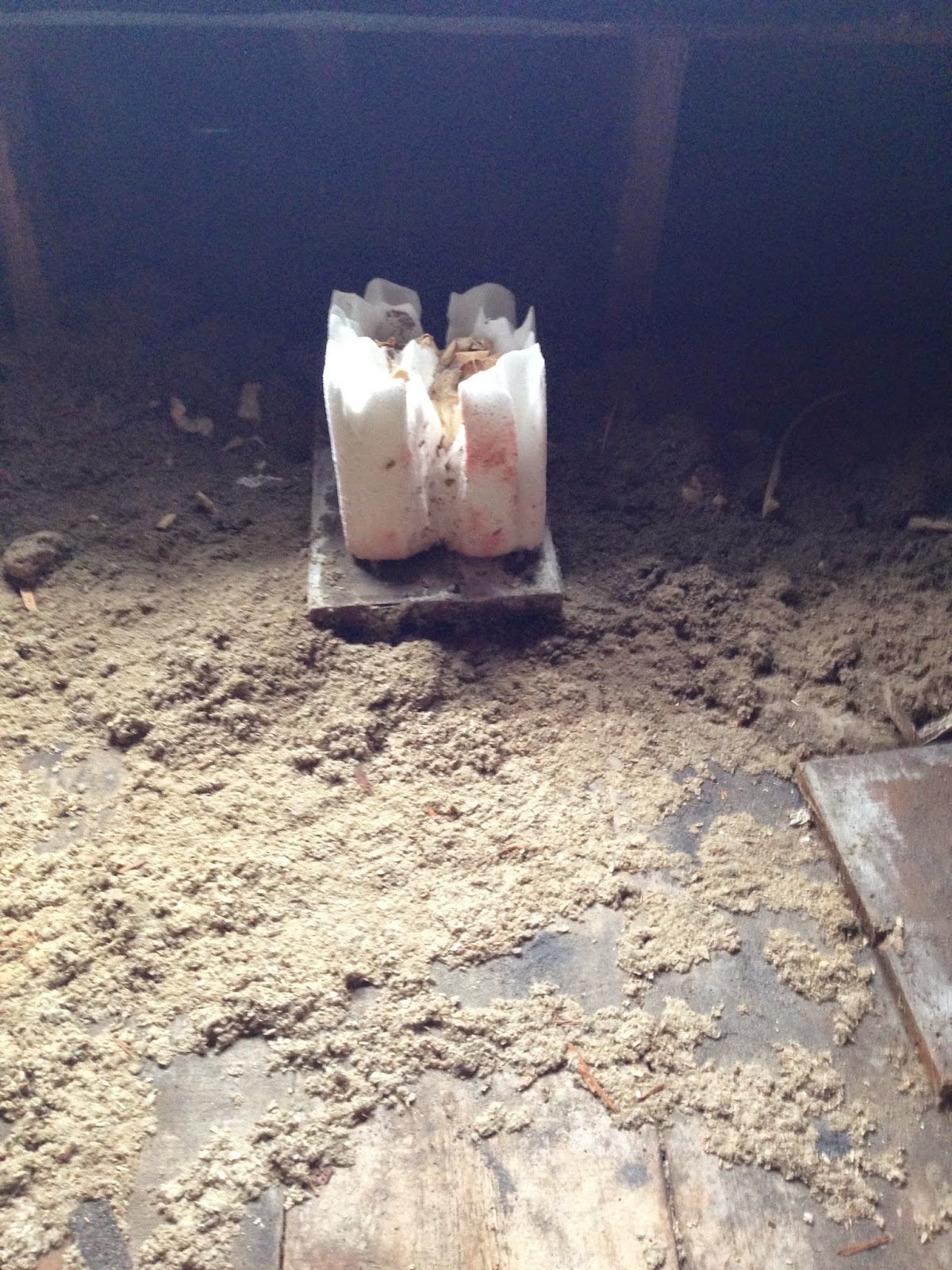
Organized by Petra Halkes as part of her ongoing Research in Art project (RIA), the Art in Odd Spaces house tour, which took place on two weekends this May, was inspired by a Deborah Margo installation that came out of a RIA residency that saw Margo place salt licks in unexpected places throughout Halke's home. That installation has triggered a series of responses that Halkes has called tangents, of which Art in Odd Spaces is the sixth. Proving to be remarkably fecund, Margo's salt licks, entitled The Traffic of Matter, remained in Halkes' attic as part of the tour.


Deborah Margo, The Traffic of Matter, 2014, installation view RIA House Tour

Five homeowners responded to a call to make their odd spaces available for an installation like Margo's, and five additional artists were selected for the task (Gail Bourgeois, Vera Greenwood, Dipna Horra, Stephanie Nadeau, and Svetlana Swinimer). Each responded to their assigned space with her own artistic stratagem.

I wrote about the exhibition for the May 20 Akimblog, and you can read the whole thing by following this link.