Tuesday, August 26, 2014

Land Reform(ed) at Âjagemô in Ottawa

Land Reform(ed) at Âjagemô invites the viewer to re-examine notions of the Canadian landscape in contemporary art. The exhibition is the first to be installed in the new gallery at the recently developed Performance Court where the Canada Council for the Arts is the anchor tenant. The Council moved there at the beginning of the year and Âjagemô opened in June to give the organization an attractive street presence. The space will be used to show off the holdings of the Canada Council Art Bank, which has been collecting Canadian artworks since 1972 and renting them to government and corporate clients. Land Reform(ed) offers a quick thematic tour as delineated over the past four decades by some of Canada’s greatest hit-makers.

Marlene Creates, Larch, Spruce, Fir, Birch, Hand, Blast Hole Pond Road, 
Newfoundland 2007 (and ongoing), 2007 (photo: Brandon Clarida)

Curated by Stanzie Tooth during an internship for her MFA at the University of Ottawa, the exhibition offers scant evidence that contemporary Canadian artists naïvely celebrate a direct communion with an unspoiled wilderness. Even the most innocuous project on view, a series by Marlene Creates where the artist photographed her hand against tree trunks, demonstrates that Canadian artists do not leave the landscape untouched by their interventions.

The complete text of my review of the exhibition was published here on the August 26th Akimblog.

Tuesday, July 15, 2014

Beyond the Edge at the Central Experimental Farm in Ottawa

Recently, on a beautiful summer day, I visited Beyond the Edge: Artists' Gardens, an exhibition at the Central Experimental Farm in Ottawa. Curated byJudith Parker and Mary Faught, the exhibition features five projects by six artists (Barbara Brown, Karl Ciesluk, cj fleury, Deirdre and Glynis Logue, and Deborah Margo) on six sites throughout the Agriculture Canada Research Plot. Using existing and new plant material as a medium, the artists cultivate a hybrid of artistic and scientific research across ten acres of the historic working farm and research centre founded in 1886.


Karl Ciesluk, Mechanical Spiral, 2014, installation view

Beyond the Edge: Artists' Gardens is the inaugural project of the Canadensis Botanical Garden Society, a volunteer organization working to institute a national botanical garden on the same site. At present, the site (and the exhibition) offers a pastoral, if not rural, respite from the urban environment in the very heart of the city.

I wrote about the exhibition for the July 15 Akimblog, which can be read in its entirety by clicking on this link.

Thursday, June 19, 2014

The Great Stone Face

I laughed, cried and split my side while writing a text to contribute to the catalogue for I Laughed, I Cried, I Split My Side an exhibition organized and curated by Dagmara Genda for AKA artist-run centre in Saskatoon, Saskatchewan from 2 May to 20 June, 2014. The exhibition explores the manner in which horror and humour intersect in works by the artists Kyle Beal (Calgary), Erica Eyres (Glasgow, UK), Christine Negus (London, ON) and Shanell Papp (Lethbridge, AB).


Christine Negus, Ditto, 2013
, engraved razor blade, silver thread.

The catalogue was launched on June 19 at the Frances Morrison Central Library in Saskatoon as part of  a night of book sales, signings and readings to celebrate and launch recent exhibition catalogues and publications produced by galleries in Saskatoon, including AKA artist-run centre, BlackFlash Magazine, College Art Galleries/Kenderdine Art Gallery, Kimiwan Zine, Mendel Art Gallery, and PAVED arts.

The following is an excerpt from my essay, The Great Stone Face:

“When stand-up comics perform, they either “kill” or “die.” The use of these words in comedic shop talk reveals an antagonistic power dynamic between comedians and their audience. But the artists in the exhibition I Laughed, I Cried, I Split My Side are not your garden variety comedians. They are different, as Dagmara Genda notes in her curatorial essay. They are deadpan. The deadpan inhabits an ambivalent, ambiguous zone of the undead where the rules that distinguish between killing and dying don’t necessarily apply. As in the etymology of the word, the deadpan presents a dead “pan” or face, like Buster Keaton’s great, emotionless, stone face.”

The complete text, and more, was available for a short period of time on the AKA website as a downloadable e-text pdf. Now, in order to get a copy you will have to look for Tragedy Plus Time.

Tuesday, June 17, 2014

Rehab Nazzal at the Karsh-Masson Gallery in Ottawa

In each work in the exhibition Invisible, at the Karsh-Masson Gallery from 9 May to 22 June 2014, the artist Rehab Nazzal employs a formal device that actually obstructs the full expression of the content presented. For example, the 2010 video Bil'in combines the sound of a crowd getting tear gassed with out-of-focus images and abstract flashes of colour, as if the camera too were blinded by tear gas. At the heart of the exhibition are works that utilize found footage of a military exercise at a prison in Israel resulting in the injury and death of Palestinian political prisoners. Frames from the Negev Prison is an installation of 1,700 4"x 6" digital prints that runs the length of one gallery wall. The individual prints make up a mosaic that represents a highly pixelated image, with completely black "tiles" indicating footage that was suppressed by the authorities, and others offering only limited views of the events.


Rehab Nazzal, Frames from the Negev Prison, 2013, 1700 digital photographs on paper (detail)

In an artist's talk on June 1, Nazzal said her work formalizes the process of making visible that which has been suppressed. The works remain incomplete in order to betray the force of suppression. Above all, the works invite the viewer to look further into what is only being partially presented. Most certainly, Nazzal's exhibition and the works within it have made the dialogic visible, creating the space for a polyvocal response.

I wrote about the exhibition on the June 17 Akimblog. For the complete text, click on  the following link.

Thursday, June 12, 2014

Petra Halkes: Lights On!


My review of "Lights On!" at the Cube Gallery in Ottawa from 2 - 26 January 2014 is on newsstands this summer, appearing in issue 130 of Border Crossings. An exhibition by the Ottawa-based artist, writer, and curator Petra Halkes, “Lights On!” was comprised of recent oil paintings that reproduce the aesthetic qualities of hasty snapshot photography in order to defamiliarize everyday scenes and make them seem otherworldly. Curated by Marcia Lea, the exhibition included selections from two related bodies of Halke’s work, her Window Shopping series and her Reflections series. In both series, Halkes refers to source photographs in the production of her paintings, and she plays up the accidental effects of the lens-based imagery in them, underscoring the disproportionate time and materiality of their making. Halkes confounds the traditional conception of a painting as a window onto the world by superimposing the perspectival planes of more recent technological developments, multiplying windows to other possible worlds.

For the complete review, check out Border Crossings 130, available at the finest bookstores, newsstands, and libraries near you.

Tuesday, May 20, 2014

Art in Odd Spaces: An RIA House Tour in Ottawa

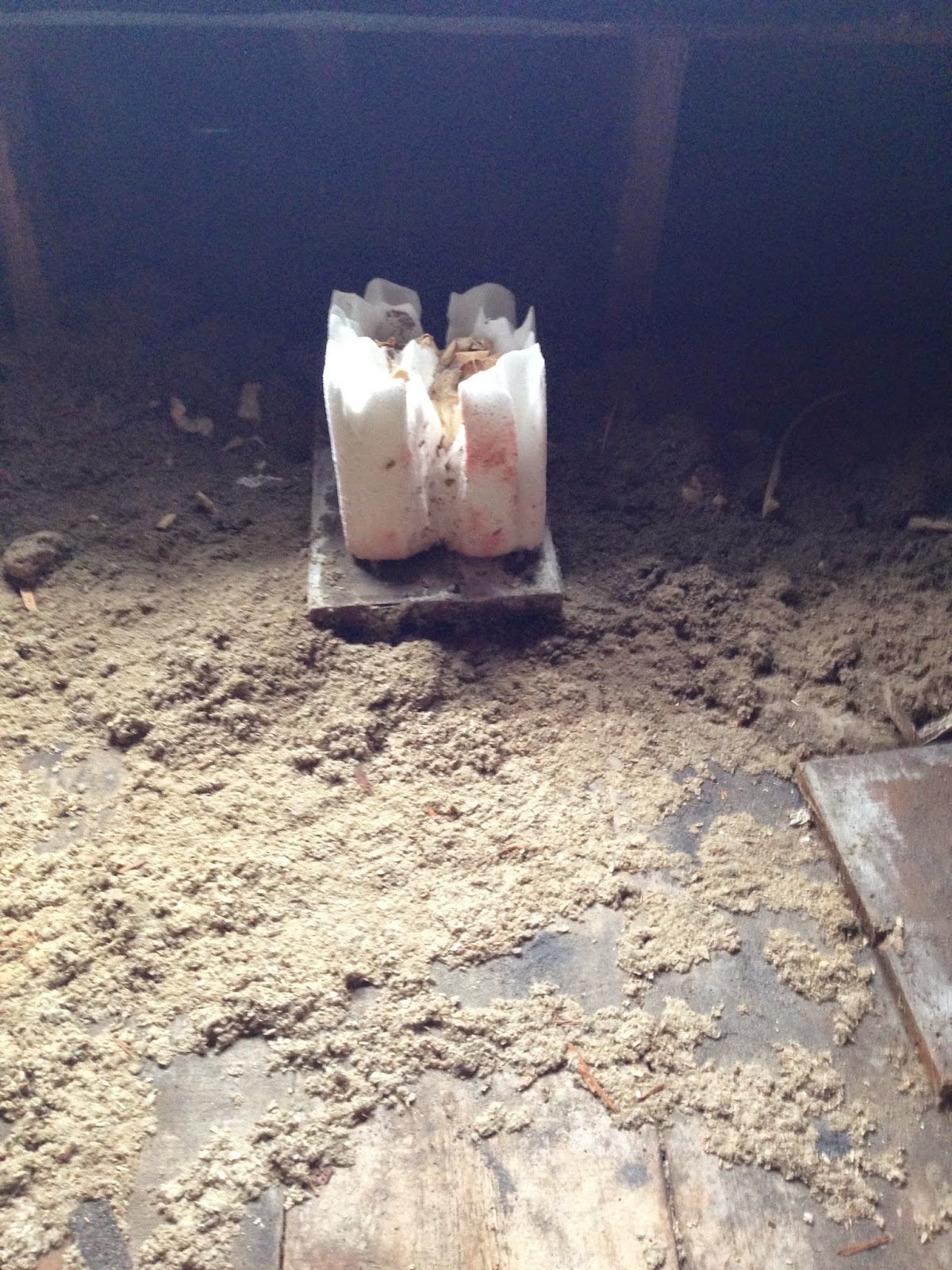
Organized by Petra Halkes as part of her ongoing Research in Art project (RIA), the Art in Odd Spaces house tour, which took place on two weekends this May, was inspired by a Deborah Margo installation that came out of a RIA residency that saw Margo place salt licks in unexpected places throughout Halke's home. That installation has triggered a series of responses that Halkes has called tangents, of which Art in Odd Spaces is the sixth. Proving to be remarkably fecund, Margo's salt licks, entitled The Traffic of Matter, remained in Halkes' attic as part of the tour.


Deborah Margo, The Traffic of Matter, 2014, installation view RIA House Tour

Five homeowners responded to a call to make their odd spaces available for an installation like Margo's, and five additional artists were selected for the task (Gail Bourgeois, Vera Greenwood, Dipna Horra, Stephanie Nadeau, and Svetlana Swinimer). Each responded to their assigned space with her own artistic stratagem.

I wrote about the exhibition for the May 20 Akimblog, and you can read the whole thing by following this link.

Tuesday, April 15, 2014

The Governor General's Awards at the National Gallery in Ottawa

An exhibition featuring the laureates of the 2014 Governor General’s Awards in Visual and Media Arts is at the National Gallery of Canada from March 28 to August 10, 2014. Rhiannon Vogl, Curatorial Assistant of Contemporary Art at the NGC, had the challenging task of putting together an exhibition with a limited footprint that would highlight not only the careers of the laureates but also the holdings of the gallery’s permanent collection. With economical grace, Vogl selected, in collaboration with the artists, one or a few works by each to represent their accomplishments.


Kim Adams, Minnow Lure, 2004, galvanized steel and mixed media (courtesy: National Gallery of Canada, Ottawa; photo © NGC)

By concentrating on the thematic relationships established by Vogel, one can discern how each artist in the exhibition (Kim Adams, Angela Grauerholz, Carol Wainio, Sandra Brownlee, Jayce Salloum, Max Dean, and Raymond Gervais) manipulates or creates objects that act as devices for knowledge or memory transmission. Another recipient of the award this year is former National Gallery of Art curator Brydon Smith, whose contribution to the arts in Canada is clearly manifested in the works acquired by the gallery during his tenure, designated by special labels for at least the duration of the exhibition.

I wrote about the exhibition for Akimblog on April 15, 2014. You can read the complete text by clicking on this link.