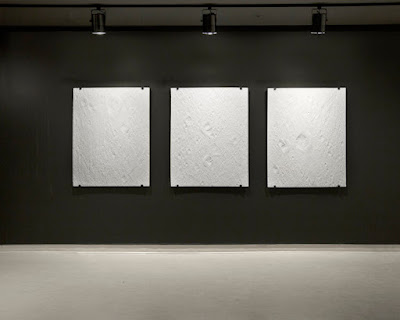
This summer I reviewed the exhibition Innerline which consisted of three recent and concurrent series of process-driven works by Nikki Middlemiss that complement each other and create an environment conducive to reflection and contemplation, further enhanced by the climate-control in the gallery where it was displayed.
Thursday, July 16, 2026
Nikki Middlemiss at Karsh-Masson Gallery, Ottawa
Tuesday, May 12, 2026
BlackFlash Artist Profile: Joyce Joumaa
The Spring issue of BlackFlash (43:1) includes an artist profile that I wrote, entitled "Joyce Joumaa: Prologue to Future Possibilities." The occasion for this profile was Joumaa's exhibition "Prologue" at the Galerie UQO in Gatineau, Quebec, which ran from January 21, 2026 to February 21, 2026. The profile offers a capsule survey of Joumaa's previous body of work in order to provide context for an interpretation of the works on view at Galerie UQO.
Although Joumaa has tackled a range of geopolitical issues, a major focus of her investigations has been Lebanon and its history. The exhibition can be understood as a prologue to a deeper understanding of historical conflict in the region and the way it has been represented to the public. Considering her other work, I identify a common aesthetic strategy employed by the artist: By leaving deliberate gaps between (and even within) related elements, Joumaa compels viewers to fill in the blanks by traversing the space of their installation, taking a closer look, and participating in the accretion of knowledge.
Thursday, March 26, 2026
Material Journeys at Carleton University Art Gallery, Ottawa
In the spring, I took a close look at the exhibition Material Journeys at the Carleton University Art Gallery and wrote about it for the Akimblog. Through gallery didactics, the curators Heather Anderson and Kathryn Desplanque encouraged viewers like to me connect the way that the artists in this group exhibition engaged with materials to the relationships they might have with their own possessions. The wall label at the entrance asked, "What did you bring here with you?" I couldn't help but think of the immaterial things one might bring as well, such as assumptions and preconceived notions about art. My own responses were affected by the reading I had been doing prior to my visit.
The phrase, "Only where material is employed as media is there expression and art," from John Dewey’s Art as Experience resonated with me and made me pay close attention to the list of materials on the wall labels for each artwork. I appreciated the manner in which the artists in the exhibition, Marisa Gallemit, Zoe Kreye, and Sukaina Kubba, put their materials to work, expressively and impressively, in strikingly different ways. Ultimately, the exhibition offered a beautiful and moving experience. The brightly coloured and airy environment it provided, though tinged with dark undercurrents of grief, vulnerability, and trauma, reinforced the power of art as a bulwark against devastation and loss. For the full text of my review check out the March 26 post on the Akimblog.
Wednesday, January 7, 2026
Archives by Artists in Esse
Tuesday, December 30, 2025
Erica Rutherford in Border Crossings
My review of the exhibition "Erica Rutherford: Her Lives and Works," at the National Gallery of Canada from June 13, 2025, to October 15, 2025. appeared in the December 2025 issue of Border Crossings. Curated by Pan Wendt, the exhibition admirably conveys the many chapters of the artist’s life. Born Eric Rutherford in Edinburgh, Scotland, in 1923, she led an adventuresome life, travelling between the UK, South Africa, Ibiza and the US, trying her hand at various artforms with success, including theatre, film, sculpture, painting and printmaking, before ultimately finding herself on Prince Edward Island by 1985.
Erica Rutherford, The Coat (The Mirror), 1970, acrylic on canvas, 127.2 × 122 centimetres. Collection of National Gallery of Canada, Ottawa, 2025. © Estate of Erica Rutherford/ CARCC Ottawa, 2025. Courtesy National Gallery of Canada, Ottawa.
Because of the dissimilarities in the style and subject matter of the works in the exhibition, it might not be immediately apparent that they were created by the same artist. Wendt provides a coherent throughline with a focus on Rutherford’s gender transition that pulls together details that are present throughout, which does not feel reductive, however, because the works themselves remain open to interpretation and refuse to be easily categorizable. Rutherford was a pioneer whose life and work create a compelling narrative consisting of many fascinating twists and turns. The full text of my review can be read here on the Border Crossings website.
Thursday, December 18, 2025
2025 Akimblog Critics' Picks
Thursday, October 30, 2025
vert soleil green sun at AXENÉO7, Gatineau
Pologne-en-Québec, a major video installation in two galleries at AXENÉO7 by Kinga Michalska and Sarah Chouinard-Poirier, is undoubtedly the best work of art about the pandemic that I have seen yet, tapping into the insecurities, fears, and sense of potentiality that existed during the suspended time of the lockdowns. It is in fact a product of a so-called Autoresidency at the centre, which was the method of providing support to artists they instituted during that period. Elements in the videos appear in the physical environments created for their viewing, loosening the boundaries between the two as well as contributing to the blurring of the lines between reality and fiction that occurs in them.
In a third gallery, another Autoresidency project by AM Trépanier, soif de communauté / hungry for community, presents oral, visual, and archival documentation of rural communes created by women, trans, and non-binary people in the area. At least one still from Pologne-en-Québec appears in this material, mingling fact with fantasy. The oral histories are also presented in a fanciful manner on audio cassette players resting on a low table with funky cushions, connecting again with the work presented in the other galleries. Both projects engagingly explore the pleasures and pitfalls of interpersonal dynamics and the lure of nostalgia. The complete text of my review of the exhibition was published here on the October 30 Akimblog.
Friday, August 15, 2025
Camille Turner and Yaniya Lee in C Magazine
The fall issue of C Magazine (161) contained my letter to the editor regarding the previous issue's interview with Camille Turner, which gave me additional insight into a work that Turner produced in collaboration with Yaniya Lee that I encountered in the exhibition Archives by Artists which was at Galerie UQO between March 12, 2025 and April 12, 2025.
For me, the blank cards in the Black History Navigational Toolkit (2021) perfectly captured the notion of "Extra Life" that was the theme of the issue. With reference to the duration of a video game, the play of meaning in an artwork is extended by the multiple lives that it can engage.
Thursday, May 29, 2025
Joyce Wieland at the National Gallery of Canada, Ottawa
Pucker Up! The Lipstick Prints of Joyce Wieland is billed as a vignette exhibition, presented in association with a major retrospective of Wieland’s work, Heart On. Celebrating an acquisition that completes the National Gallery of Canada’s collection of Wieland’s so-called lipstick prints, this show is an amuse-bouche in relation to the travelling survey; nevertheless, when considered alongside works by other artists currently on view at the gallery, Pucker Up!’s limited scope still underscores Wieland’s concerns with equity and cultural sovereignty in a manner that resonates with current debates.
Joyce Wieland, The Arctic Belongs to Itself, 1973, lithograph on wove paper (© National Gallery of Canada; photo: NGC)
I recalled Wieland on the same visit while viewing the New Generation Photography Award exhibition where I encountered the work of asinnajaq, a Canadian Inuk artist from Inukjuak, Quebec. Featuring details of nature and terrain, her prints, unframed and affixed to the wall with magnets, or on a piece of synthetic fabric bunched up in the centre of space, reminded me of the provisional and performative aspects I discerned in Wieland’s work. Through artworks like The Arctic Belongs to Itself (included in Pucker Up!), Wieland raised awareness about Indigenous rights and the threat of environmental devastation. In accordance with Inuit values, asinnajaq similarly expresses a love of the land. Her video holding piece, like Weiland's work, suggests that an act of loving care can also be an act of resistance. The complete text of my review of the exhibition was published here on the May 29 Akimblog.
Tuesday, July 5, 2022
The Arnold Trevor Tolley Art Collection
My essay, "Unexpected Revolutionaries," was published in The Arnold Trevor Tolley Art Collection in 2021 but I didn't see a copy of it until 2022 due to the delays and the upheavals of the pandemic. Produced by Glenda M. Patrick, the publication is meant to be a memorial to her husband A.T. (Trevor) Tolley (1927-2018) and a document of the art collection that they built together at their home on the Seven Willows estate in Williamsburg, Ontario.
Cover image: Meryl McMaster, Secret Darkness of Birds, 2016 (detail).
My essay uncovered the way that chance encounters and personal connections are enabled by an approach to art that is open and exploratory in character, characteristics that largely describe the artworks in Glenda and Trevor's collection. In what struck me as an incredible coincidence, during my visit with Glenda at her home, I found myself looking at a view from an apartment I had briefly inhabited decades earlier in Montreal, depicted in a painting by one of my roommates, Christopher Arnoldin. Only now, through reference to the title of his painting, do I realize that we also shared an appreciation of the Red Hot Chili Peppers.
Postscript: I was saddened to learn of the death of Glenda M. Patrick (1938-2026) and want to add that the Arnold Trevor Tolley Art Collection was a testament to her passion for and support of the arts as well. I have a very pleasant memory of meeting with her and touring her home to survey the collection while researching my essay.
Monday, April 19, 2021
On the Passage of a Few People...
I got word today that the 2017 edition of Mémento was now available on the Est-Nord-Est website. Understandably, the past few years have been demanding for the organization, with the construction of a new building, staff turnover, and a global pandemic, but now their documentation is up to date, and on a new website too. You can download a pdf of the publication by clicking on the cover image below.
The publication covers the three residency periods that were held at Est-Nord-Est in 2017, and my essay describes the work of the artists in the Fall residency, for which I was the writer in residence.
On the Passage of a Few People…
On my way from Ottawa to Est-Nord-Est in Saint-Jean-Port-Joli, I was thinking about “infrastructures of resonance.” The phrase had just been introduced to me by a professor at Carleton University when I was giving a tour of an exhibition that I had curated about the punk rock scene in Ottawa in the 1980s. He had been teaching the concept with reference to Nato Thompson’s Seeing Power (2015), and he told his class that the punk rock zines in the exhibition were perfect examples. Thompson describes infrastructures of resonance as projects that form a network of affiliations, and you can certainly see this in a zine as it gets circulated and shared by fellow punks. A zine, like any work of art, not only makes ideas public but also creates a public through its reception.
Approaching Saint-Jean-Port-Joli, along the river. Photo: Michael Davidge
Through their programming, publications, and other activities, artist-run centres such as Est-Nord-Est could also be considered infrastructures of resonance. Operating in communities both big and small across Canada, they actively promote and support the production and exhibition of contemporary art and the exchange of ideas that offer an alternative, and often critical, point of view on mainstream culture. I was looking forward to meeting and conversing with the other artists in residence: Jennifer Belair, Sophie Madeleine Jaillet, Christoph Mügge, and Céline Struger. In advance of the residency, I had another phrase in mind: “On the passage of a few people through a rather brief moment in time.” Many years ago, a friend of mine lent me an exhibition catalogue with that title, taken from a film made by Situationist theorist Guy Debord, and it has continued to resonate with me. I was thinking of it partly because of the connections between Situationism and punk rock, but also because of the generic yet poignant applicability of the phrase. I wondered what encounters or exchanges had influenced or inspired the other artists at Est-Nord-Est. I would try to find out over the course of the next month.
Céline Struger, Studio installation view (detail), 2017. Photo: Jean-Sébastien Veilleux.
The body of work that Céline Struger developed during her two-month stint at Est-Nord-Est was the most directly inspired by the environment surrounding the artists’ residence and studios. Struger is an Austrian artist from Vienna who works in installation as a counterpoint to virtual reality. She uses both found and fabricated materials to create an alternate reality that questions concepts of value. The prominence of the St. Lawrence River in Saint-Jean-Port-Joli was manifested in the forms of the pieces that Struger created for an installation in her studio, which were derived either from a sketch that she drew of the shore of the river and its fascinating rock formations or from the objects that she found strewn along the shore, such as plastic six-pack rings. The installation incorporated these objects, including a sizable piece of charred wood and a rusted-out piece of machinery, suggesting an equivalency among the forms. A number of the pieces were ceramics fired in the Est-Nord-Est studio kilns. All of the ceramics were treated with an Obvara glaze, introduced to Struger by Judith Dubord, a local artist. Est-Nord-Est encourages and facilitates such interactions between local and visiting artists. Obvara firing, which creates a surface pattern that is said to ward off the evil eye, appealed to Struger because of her interest in the power of materials, both literal and symbolic. Through her treatment, quotidian objects are transformed into alien life forms that invite a re-evaluation of what can be known about them.
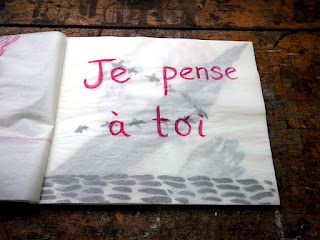
Because her practice is conceived as a kind of journaling, the work that Jennifer Belair produced at Est-Nord-Est also contained a strong connection to its location in Saint-Jean-Port-Joli. Belair is an American artist currently living in Detroit, Michigan. With a printmaking background, she generally works on paper and makes drawings that incorporate observations of her surroundings with snatches of overheard conversations or thoughts that reflect her mental state at the time of their composition. For a while now, she has been working in a vein that mines the romantic tradition of the landscape genre, and the environs of the Bas-Saint-Laurent region lent themselves easily to this tendency in her work. Languages other than English appear in her drawings as a way to reach different audiences and as a visual element that expresses otherness. Reflecting the context in which she found herself, French appears in the drawings she made in Saint-Jean-Port-Joli. A fan of country-and-western music, also because of its romanticism, Belair expanded her pantheon of musical heroes when she discovered French-Canadian country and western singer Willie Lamothe on the cover of a magazine in the local grocery store. She also ran a bookmaking workshop organized by Est-Nord-Est. By teaching a group of women at the Centre-Femmes La Jardilec to produce their own books that could be used as journals, she was a source of inspiration for Saint-Jean-Port-Joli as much as she drew inspiration from it.
Although her work is very much about the environment, Sophie Madeleine Jaillet did not draw specifically from Saint-Jean-Port-Joli for the subject matter of the work produced during her residency. A French-Canadian artist who lives and works in Montreal, Jaillet makes art as a method of performing the Anthropocene, the current geological period in which human activity is the dominant influence on climate and the environment. Her work often appears to be a kind of science experiment that renders abstract thought tangible. While at Est-Nord-Est, she made a series of “drawings” on Mylar by melting blocks of ice with graphite frozen within them, producing a visual analogue for the process of glaciation. Jaillet was also working on a piece that included a small set of quartz Platonic solids that represent an obsolete paradigm for understanding the universe. These solids are to be eroded in a rock tumbler. Although she works in a broader way with the environment, while in residence Jaillet took advantage of the specific resources that Est-Nord-Est makes available to artists and worked closely with technician Richard Noury to create fine wooden boxes and display cases for the Platonic solids. Through her work, and through the interactions that she has with people about it, she raises concerns about the intangibility of science and strikes a cautionary note. By asking questions that aren’t typically posed (by asking scientists “Are you hopeful for the future?” for example), she fulfils an important artistic role.
Christoph Mügge, Studio installation view (detail), 2017. Photo: Jean-Sébastien Veilleux.
Although the work that Christoph Mügge produced during his residency seems the furthest removed from the context of Saint-Jean-Port-Joli, there is still an underlying connection with it. A German artist who lives and works in Malmö, Mügge created a series of woodcut prints that drew inspiration from the signs for bomb shelters, or skyddsrum, that are prevalent in Sweden. With a background in painting, Mügge has more recently turned to making large-scale installations with trash and recycled materials. In doing so, he comments on consumer society by revealing the excess of waste that is available for him to work with. At Est-Nord-Est, Mügge was able to use scraps from the wood shop to create his work. By the end of his residency, Mügge had finished a series of 36 editioned prints, each of them based on the design of the Swedish signs (featuring a blue triangle in an orange square) and incorporating cultural references related to bomb shelters. For example, in one of his prints the blue triangle resembles the shell of Bert the Turtle, the cartoon star of the “social guidance” film Duck and Cover produced in the United States during the height of the Cold War. With the heightening tensions among nuclear powers today, it is not surprising that Mügge would be focusing on this subject. However, it is also not that surprising that he produced a woodcarving of a turtle during his residency, given the rich history of woodcarving in Saint-Jean-Port-Joli.
As our residency drew to a close, the artistic director, Dominique Allard, asked all of the participants to give a list of five texts or references related to our research and production at Est-Nord-Est so that she can share them on the centre’s website. My list includes London Orbital (2002) by Iain Sinclair, which I managed to finish reading while I was there. From Sinclair’s book I gleaned an important distinction between the Greek philosophical concepts of chora and topos, which could be roughly translated as space and place, respectively. Est-Nord-Est is a kind of space that is oriented to being open to the acceptance of different ways of looking at things, and to different people who come from all over the world, if only for a brief moment in time. Although our list of references undoubtedly informed our production at Est-Nord-Est, I would say it was our encounter with the place where it is located and with the people who are there that had an even greater influence. As an infrastructure of resonance, the significance of the residency is further relayed through the projects that it supports and sends back out into the world.
Thursday, February 25, 2021
Neeko Paluzzi at the Karsh-Masson Gallery, Ottawa City Hall
I wrote the exhibition essay for Neeko Paluzzi's The little prince, an exhibition at the Karsh-Masson Gallery at Ottawa City Hall from February 25, 2021 to April 11, 2021. In spite of the disruptions caused by the pandemic, it was a pleasure to be involved and to see the exhibition installed. The text of the essay was only available as a didactic on a wall in the gallery, so I am reproducing it here in full:
Constellations.
Neeko Paluzzi, Homunculus (detail), 2019, pigment ink on cotton rag
It is always entertaining and illuminating to hear Neeko Paluzzi talk about his artwork. His technically rigorous approach to making art is matched by an intellectual curiosity that drives its production. He is usually either in the finishing stages of an ambitious project or embarking on a new one. The artist imbues each project with great significance through copious research and reference materials. At first, his work can appear abstract and seem to transmit minimal information. However, the work remains sufficiently open to interpretation for viewers to connect with it in their own way.
For example, when I met him to talk about the work displayed in his exhibition The little prince, he noticed that my notebook had a constellation of stars on its cover. It was a happy coincidence that this image should relate to the content of the exhibition, which explores outer spaces, both real and imagined. Later in our conversation, Paluzzi mentioned that he is from the small town of Turkey Point, Ontario. I remembered seeing old photographs of my Dad’s family spending their summer vacations there, years ago. Auspicious coincidences like these can accrue around a work of art and lend it a patina of significance.
If such coincidences or associations are given any weight, they can form a constellation of ideas that provide a framework for interpreting an exhibition. With his exhibition at the Karsh-Masson Gallery, Paluzzi refers to the children’s book by Antoine de Saint-Exupéry. The book mourns the loss of imagination that often occurs when a child grows into adulthood. Tellingly, the book is dedicated not to the grown-up dedicatee but to the child from whom he grew. Viewers who have read the book will be able to bring their own recollections of it to bear on their visit to the gallery.
Neeko Paluzzi, The view from my bedroom (left) | The little prince, 2020 (right)
Even those unfamiliar with the book will surely notice the atmosphere of nostalgia and references to childhood that permeate the exhibition. One image shows the artist as a little kid, dreaming of becoming an astronaut, his face peeking out of a photo stand-in spacesuit. The body of work on view was actually inspired by a visit to Paluzzi’s childhood home. He describes the experience of sleeping in his old bedroom, represented by an enlarged photograph in the exhibition: “Once the feelings of nostalgia faded, thoughts entered my mind about failing to become who I wanted to be.” However, the work in the exhibition does not simply capture this notion of realizing your limitations as you age. It is also very much about addressing these limitations and overcoming them through imagination and art. Paluzzi may not have grown up to be an astronaut, but through his art he can project himself, and his audience, into outer space.
At the centre of the exhibition is a series of images directly inspired by the narrative of The Little Prince. Seven dioramic images of seven sculpted figures on seven little planets/asteroids roughly correspond to the characters in the book: the king, the flower, the snake, etc. (These images have also been prepared to be seen through a View-Master, another item that Paluzzi associates with his childhood.) It is not easily discernible that many of the figures in the images are actually 3D printed miniatures of Paluzzi’s body. With these images, Paluzzi exploits the characteristics of photography to lend a real existence to the subjects depicted. 3D printing also enables Paluzzi to underscore the sculptural qualities of photography. In this vein, the artist brings the lunar surface within reach by hanging, on the back wall of the gallery, a series of 3D etched wood sculptures that replicate photographic images taken of the Moon in 1968.
It might appear that the strength of Paluzzi’s practice lies in the one-to-one relationship he sets up between his artworks and what they depict. However, the looser associations are what allow for greater communication. For example, in a related body of work Harmony of the spheres (2020), Paluzzi created a series of tone photos based on Johannes Kepler’s Harmonices Mundi, published in 1619. This text actually notates the music of the spheres, an ancient concept according to which the planets move in harmony, and assigns musical scales to each of the six known planets, as well as the Moon. Following a method that he developed for previous projects, Paluzzi uses darkroom equipment to create photographic prints in which tones of gray are directly associated with musical tones. Each of the seven prints in the series has a different tone of gray. These seven tones correspond to the chords of Kepler’s planets, which Paluzzi associates in number with the celestial bodies visited by the Little Prince. How far the viewer is willing to go along with the connections suggested by Paluzzi may depend on how deeply they accept the moral of Saint-Exupéry’s story: “It is only with the heart that one can truly see. What is essential is invisible to the eye.”
Replete with well-known and obscure references, as well as suffused with a relatable personal history, Paluzzi’s exhibition gives the viewer multiple entry points. Correspondingly, Paluzzi has produced the image of his childhood bedroom so that the window by his bed is a blank screen upon which viewers can project. You can imagine looking out the window and daydreaming of what lies beyond, be it Turkey Point or some more distant realm. Though Paluzzi has focused on his failure to realize a childhood dream, he has also transcended limits with imagination.
Friday, October 30, 2020
SAW Prize for New Works in Critical Writing
I am delighted to announce and honored that I have been selected as one of the recipients of the SAW Prize for New Works. Along with 30 other artists and makers from Ottawa-Gatineau and the surrounding First Nations, I have been given a great opportunity to create a new work with financial and organizational support provided by Galerie SAW Gallery.
I have been awarded a SAW Prize for New Works in Critical Writing, and the focus of the new text that I am going to produce will be on contemporary artists in the Ottawa-Gatineau area. I am also very excited to see what my cohorts come up with for their new productions.
Wednesday, October 14, 2020
Moyra Davey at the National Gallery of Canada, Ottawa
The Faithful, a survey exhibition of the decades-long career of Moyra Davey, brings together a body of work and weaves a dense web of references that warrants close readings. Working with text, video, and photography, the Canadian-born, New York-based artist examines her personal history and its connections to art, film, and literature to construct narratives that give meaning to her experience at the same time that they refrain from reaching any simple conclusions.
Moyra Davey, i confess (video still), 2019. HD video with sound (courtesy greengrassi, London, and Galerie Buchholz, Berlin/Cologne/New York) © Moyra Davey (photo: courtesy the artist)
At the center of the exhibition is a recent video titled i confess, which bridges an appreciation of the American author James Baldwin with a reexamination of Pierre Vallières, the Quebec writer who compared the separatist movement with civil rights struggles in the US. On the 50th anniversary of the October Crisis, amid anti-Black racism protests, its presentation in Ottawa couldn’t be more timely. Like Davey’s other work, it also reveals personal details of her own life, delving into her father’s possible role in the invocation of the War Measures Act, and her ex-boyfriend’s relationship with Vallières.
There is a recurring motif in a number of the videos in the exhibition, where Davey goes over to an open window in her apartment and blows the dust off the top of one of her books. It is a ritualistic gesture that suggests we must repeatedly reexamine the past, our own memories, and received ideas. The complete text of my review of the exhibition was published here on the October 14 Akimblog.
Thursday, September 3, 2020
Neeko Paluzzi at Studio Sixty Six, Ottawa
Neeko Paluzzi's Harmony of the Spheres (from August 21 to Sept. 13) is one of the few exhibitions I got out to see at a gallery since everything went into lockdown in March at the start of the pandemic. For this exhibition, the artist has systematically produced seven photography-based works that represent the seven heavenly bodies (including the moon) that comprised the known planets when the astronomer Johannes Kepler wrote Harmonices Mundi in 1619. In his treatise, Kepler transcribed the tones attributed to the planets, which, according to the ancient concept of the Harmony of the Spheres, together made a sound that showed the harmonious perfection of Divine creation. Utilizing a method he developed in previous installations, including This place is a shelter (2018) and The goldberg variations (2019), Paluzzi worked in the darkroom to produce prints with unique tonalities of gray that correspond to the musical tones associated with each of the seven planets.
Neeko Paluzzi, Music of the moon, 2020, silver gelatin print and silver leaf embossed matte in custom frame
It was hard not to read the work in the context of the ongoing quarantine, where it took on overtones outside of the rigorous framework in which it was conceived. Indeed, especially due to the disruptions we are experiencing these days, one can find succor in impeccably realized creations embodying an outdated worldview that sees perfection in a pre-ordained order. On the other hand, it is important to note the element of subterfuge in these prints that underscores how most often phenomena are given their meaning by the way they are framed. The complete text of my review of the exhibition was published here on the September 3 Akimblog.
Thursday, November 28, 2019
Àbadakone at the National Gallery of Canada, Ottawa
Àbadakone is the second in a series of international Indigenous art exhibitions that was inaugurated in 2013 with Sakahàn. With reference to the fact that the National Gallery of Canada resides in traditional Algonquin territory, both exhibitions have titles in Algonquin. As Sakahàn is a word that means “lighting a fire” in English, it is totally apt that Àbadakone should mean “the fire continues to burn,” or in the trilingual title of the exhibition: Continuous Fire.
This exhibition further establishes the NGC as a centre for dialogues that contribute to the writing of international Indigenous art histories. It also makes it a place to see some extraordinary contemporary Indigenous art from around the world, with work by more than seventy artists from at least sixteen diverse countries including Benin, China, Guatemala, India, Indonesia, Japan, New Zealand, Russia, and South Africa. Significantly, these artists in total identify with approximately forty Indigenous nations, ethnicities, and tribal affiliations within and across the countries listed, traversing boundaries and shifting a visitor’s understanding of the global map.
In the complete text of my review, posted here on the November 28 Akimblog, I dwell on one work that is particularly emblematic of this shift in perspective: the Sámi Architectural Library by Joar Nango, a Sámi artist and architect from Sápmi (a cultural region that stretches over Norway, Sweden, Finland, and Russia). For Nango, the paramount goal is the transmission of Indigenous knowledge. His library offers a dynamic model for decolonization.
Tuesday, August 20, 2019
Sex Life at Galerie SAW Gallery, Ottawa
Galerie SAW Gallery is open again with a strengthened presence and a bracing new show. Curated by Jason St. Laurent, Sex Life: Homoeroticism in Drawing delivers on its promise not to shock or titillate (although the potential for that is abundant), but rather to foster an expanded view of human desire and sexual practices.
Cindy Baker, Crash Pad, 2017, watercolour on paper
Artists in the show – and featured in a special issue of HB magazine that serves as an exhibition catalogue – include Cindy Baker, Panos Balomenos, Dave Cooper, G.B. Jones, Sholem Krishtalka, Zachari Logan, Kent Monkman, Diane Obomsawin, and Mia Sandhu. They are also joined by a host of even more artists in a series of vitrines that contain additional works – mainly publications such as graphic novels, bandes dessinées, manga, underground comix, and zines. The inclusion of these materials situates the work in the show within a global community. Sex Life imagines a community representing sexual freedom explicitly in contrast to the rise of right-wing conservatism worldwide. The complete text of my review of the exhibition was published here on the August 20 Akimblog.
Wednesday, August 14, 2019
A Speculative Process: Reading Jayce Salloum’s Mute Pictures
My article on Jayce Salloum's remembering you (mute pictures) is featured in the National Gallery of Canada's Magazine. The early work, completed by Salloum between 1987 and 1988, is included in Photography in Canada 1960–2000, an exhibition organized by the National Gallery of Canada's Canadian Photography Institute and on view at the Judith & Norman Alix Art Gallery in Sarnia, Ontario.
Wednesday, July 10, 2019
Trames narratives / Storylines at L’Imagier in Gatineau
The first exhibition in the new 2.6 million redevelopment of the artist-run centre L'Imagier in Gatineau, Trames narratives / Storylines, opened in May 2019. With a title that suggests an anthology of contemporary art from Canada and Quebec, the exhibition gathers together an impressive cohort of curators and artists. Six Quebec-based curators (Kasia Basta, Marianne Breton, Paul Brunet, Marie-Hélène Leblanc, Stefan St-Laurent, and Julie Tremble), many from the National Capital Region, contributed to the development of the exhibition. They each selected one or two of the seven artists in the show (including Chun Hua Catherine Dong, David Elliott, Kablusiak, Kim Kielhofner, Carl Trahan, Jennifer Lefort, and Mélanie Myers). The number of people involved and the number of artworks that are clustered in the modest-sized gallery evoke a housewarming party.
Saturday, July 6, 2019
Bouquiniste Mobile Project Launch at EBA
Members of the Bouquinistes Collective launched our project, The Bouquiniste Mobile, at Enriched Bread Artists (951 Gladstone) on Saturday July 6 from 2 to 4 pm. Like the Bouquinistes of Paris from which the group takes its name, used booksellers on the banks of the Seine, the Bouquinistes of Ottawa mean to operate outside of official channels and contribute to the circulation of ideas.
The project brings together three text-based artists living in the Ottawa area (including myself, Mana Rouholamini and Guillermo Trejo) through a platform developed by a local artist, Adam Brown, whose work can be characterized as social practice, enabling each to present their work in a dynamic way to an audience that might not necessarily be an art audience.
Inspired by Brown’s Friendship Library, a 2014 installation on the grounds of the Arts Court which provided a temporary shelter and transformed public space into a site of cultural activity, the Bouquinistes Collective have made it their mandate to provide an accessible experience of art. The Bouquiniste Mobile can be maneuvered to capitalize on opportunities for public engagement and disseminate artworks where people gather, at parks, festivals and other events.